Style | StandardCards

Planet Interactive Fiction

Tuesday, 03. February 2026

Renga in Blue

University Adventure (1983)

Today sees the return of the tapemag T&D Subscription Software, which we last saw with the game Killer Mansion. The tapemag was started in 1982 by Tom Dykema to distribute Tandy Color Computer tapes monthly and was successful enough to last until 1991. Tom wrote a great deal of the software himself (“at the rate […]

Today sees the return of the tapemag T&D Subscription Software, which we last saw with the game Killer Mansion. The tapemag was started in 1982 by Tom Dykema to distribute Tandy Color Computer tapes monthly and was successful enough to last until 1991.

Tom wrote a great deal of the software himself (“at the rate of about four programs a week”) but had a “programming genius down the street” help him and accepted contributions otherwise. A Facebook post by Youngstown Ken talks about several games of his taken in on the tapemag, including a clone of Trek that was published in the September 1983 issue.

The publication as a whole lands on CASA as having 77 adventure games (!!) so we’ll eventually be seeing a lot more of them. Just to be thorough I checked the T & D catalog for anything they described as in the “adventure” genre after Killer Mansion. There are two tagged from 1982, Quest for Lenore (Issue 2)…

…and Terrestrial Adventure (Issue 4).

Neither quite fits what I’m calling an adventure, although Terrestrial Adventure is sort of a top-down “choose your own adventure” style game with mild action elements; you control a little green dot and if you run into anything on the map you die. (This almost feels like it is meant to parody the gameplay of the Atari 2600 game E.T. with the infamous pits, but Issue 4 was in October 1982 which is before the Atari game came out.)

The controls make a room like this perilous.

After that, there’s a long gap until the next adventure, which the listing guide calls College Adventure but the game itself calls University Adventure. Confusingly, the file is called COLLADV/BAS.

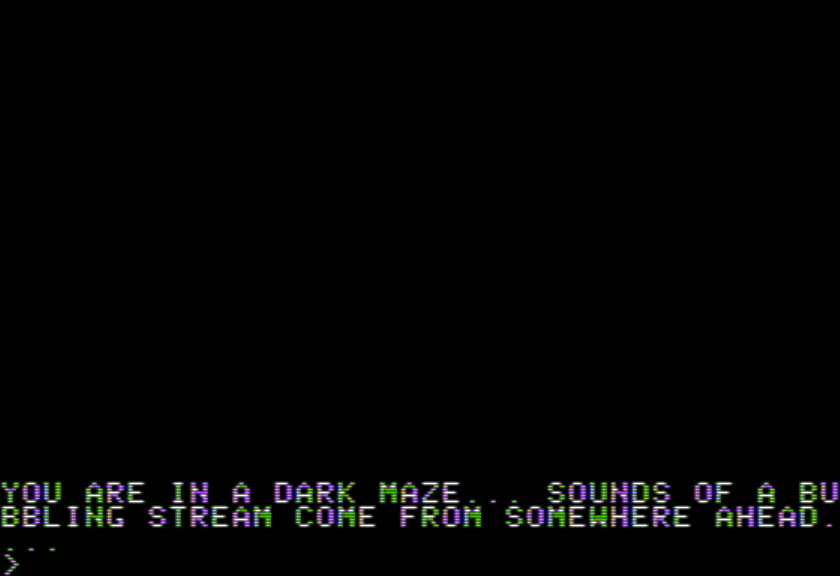
YOU MUST TREK ACROSS THE COLLEGE CAMPUS IN SEARCH OF YOUR GOAL, with no clarity what that goal might be.

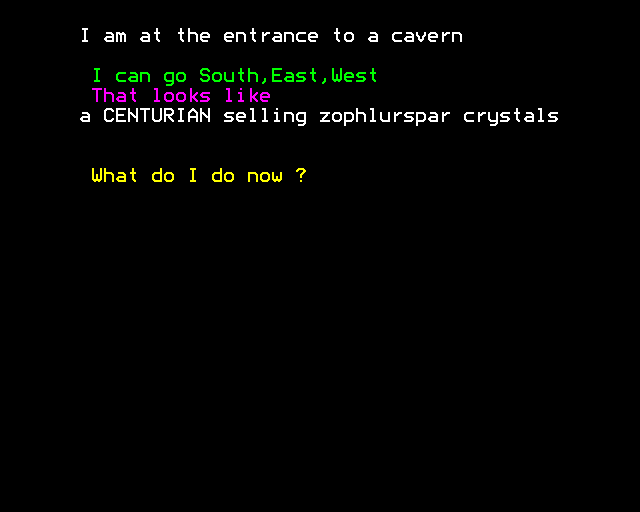
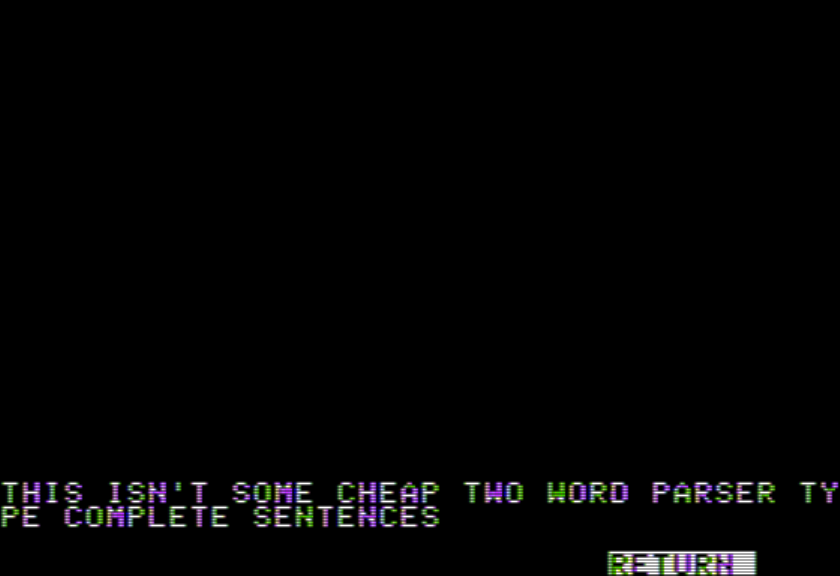
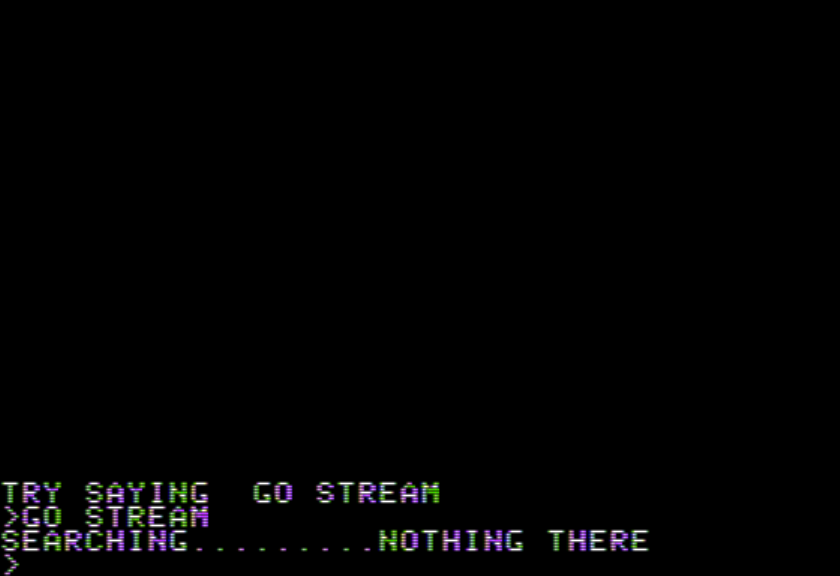
The verb list is unusual in that only the first three letters from the applicable verbs can be used. That is, from the starting room…

…and you can type GET NOTE just fine, in order to read it you must type REA NOTE, not READ NOTE. I’ve never seen this particular piece of jank before, indicating this is an author we haven’t met yet.

I’m so unused to the “shortened verbs only” setup that I accidentally typed READ in full twice.

As the note indicates, someone is being held captive in the computer center. With the beer, you can DRI (not DRINK) it until you finally end up drink.

We’re definitely on a University Adventure now! This moment where you could keep hitting Y made me laugh out loud.

If you pick up the beer and take it to the west, a resident assistant will stop you and end your adventure prematurely.

The trick is to not pick up the beer, walk on past, slip into another dorm and grab a key, avoid meeting the gang of girls down the south hall…

…and then unlock a closed door across your own dorm room…

…and pick up a pizza. While the pizza and beer are held, there is a different gang (presumably of men) who will let you pass.

Go east for long enough and you’ll find a random piece of wood.

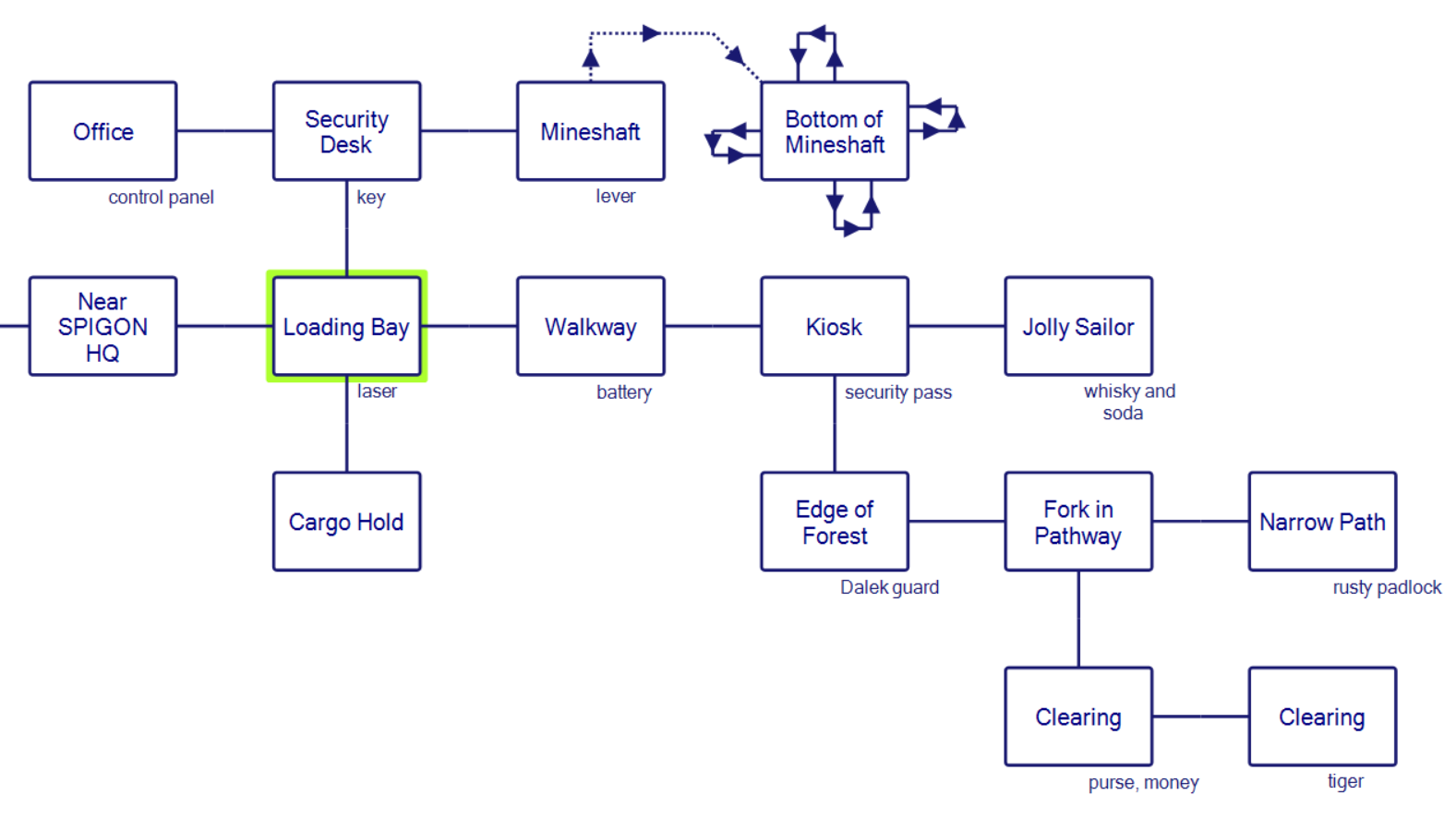
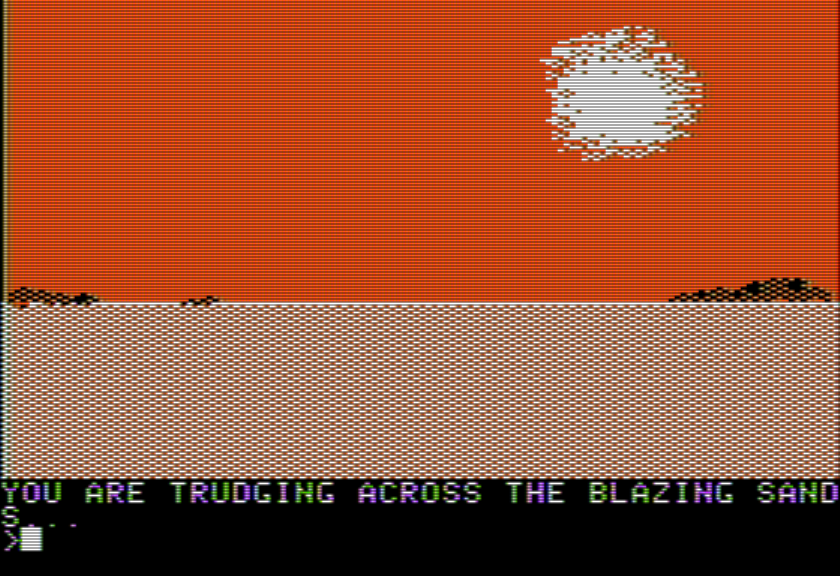
From here the only way to go is outside, and I’m going to switch to isometric mode!

I’ve left items off as the remainder of the map is mostly a red herring. There is, for instance, a cafeteria.

None of these items are useful except technically the I.D. card, where if you go south you’ll run into a safety official who will cause a game over.

However, this encounter isn’t necessary at all, because you can just avoid that spot on the map! (Not like it matters too much — the game has no inventory limit so you can scoop up everything. The only moment where this causes a problem is with the beer.)

The important item is instead down in a classroom where you can find a computer card in a classroom.

Scooping up the pencil too, because why not.

This can be taken over to the east where there’s a river that you need to USE WOOD in order to pass over…

…followed by the computer card which gets applied to a security door.

Head south and you’ll win, with no further plot explanation of who needed rescuing or if the note was just some kind of prank.

I get the impression the author was aiming for something a little more dense. The opening made me hopeful we were going to get a “my university” satire with lots of obscure references; that’s not a bad thing in this context because it means the author would be aiming at a particular target and trying to say something, even if that something is an observation on the overzealousness of campus patrol. However, they clearly gave up by the end and the red herrings start to feel more like parts of the game the author never finished with (potentially due to lack of memory space). The opening spiel to the T&D newsletter for this issue even says

WOW! The programs on this month’s tape are so long that we could barely put two copies of each on the tape…

…indicating the game couldn’t have been longer even if the author wanted it to be. At least “every verb must be written in three letters” is an odd enough aspect it will be clear if they pop up again.

Coming up: assuming I get the tech issues resolved, an early hybrid action/text adventure game in Japanese.

Sunday, 01. February 2026

My So Called Interactive Fiction Life

Official Sharpee 0.9.62-beta

I accomplished a lot of polish for an official Sharpee release, though still in beta.The story runner Zifmia has downloads for Windows, Ubuntu, and MacOS. (if other Linux distro downloads are needed, let me know and I'll add them).The website is now up to date with
Official Sharpee 0.9.62-beta

I accomplished a lot of polish for an official Sharpee release, though still in beta.

The story runner Zifmia has downloads for Windows, Ubuntu, and MacOS. (if other Linux distro downloads are needed, let me know and I'll add them).

The website is now up to date with those downloads, including the current beta and still-in-progress port of mainframe Zork aka Dungeon as a Sharpee story file (dungeo.sharpee). The website also has a thin-web version of Dungeon.

Saturday, 31. January 2026

IFComp News

IFComp 2026: Generative AI Policy Update

For IFComp 2026, we are introducing a new rule addressing the use of generative AI.The guiding principle is that judges and players should experience work created by humans. Accordingly, all player-facing content in IFComp entries, including cover art, must be entirely created by humans.Authors may continue to use tools of their choice, including generative AI tools, for development assistance such

For IFComp 2026, we are introducing a new rule addressing the use of generative AI.

The guiding principle is that judges and players should experience work created by humans. Accordingly, all player-facing content in IFComp entries, including cover art, must be entirely created by humans.

Authors may continue to use tools of their choice, including generative AI tools, for development assistance such as editing, debugging, accessibility support, research, limited translation assistance, or coding. Entries may not require judges or players to interact with external AI or generative services during play.

This rule was informed by results from the 2025 post-competition survey and discussion within the IFComp Committee. We thank everyone who shared their feedback; this post-comp survey received the strongest response we have ever had, and it helped guide the Committee’s deliberations.

That’s the update! If you’re interested in some of the information from the post-competition survey that helped inform the decision, keep reading.

Survey charts on the GAI use-case questions from the survey are shared below to give a clearer picture of the feedback we received. Alt text on these images provides the complete percentage breakdown.

How do you feel about allowing authors to use GAI to create cover art for an entry?
49.8% - Strongly Oppose
23.2% - Somewhat Oppose
12.8% - Neutral
6.6% - Neutral
7.6% - Strongly SupportALT
How do you feel about allowing authors to use GAI to create art or image assets that appear inside an entry (e.g., character portraits, backgrounds, illustrations)?
62.1% - Strongly oppose
19% - Somewhat oppose
8.5% - Neutral
4.3% - Somewhat support
6.2% - Strongly supportALT
How do you feel about entries that require judges to interact with an external AI system (for example, copying prompts into ChatGPT or another live model, or that automatically connect to a third-party AI service during play)?  
75.8% - Strongly oppose
11.8% - Somewhat oppose
6.2% - Neutral
1.9% - Somewhat support
4.3% - Strongly supportALT
How do you feel about allowing authors to use GAI to generate unedited prose, dialogue, or narrative text that appears in the final entry?  
85.2% - Strongly oppose
4.3% - Somewhat oppose
5.2% - Neutral
1% - Somewhat support
9% - Strongly supportALT
How do you feel about allowing authors to use GAI to generate prose, dialogue, or narrative text that is then edited or refined by an author prior to inclusion in the final entry?
54.5% - Strongly oppose
18.5% - Somewhat oppose
13.7% - Neutral
4.7% - Somewhat support
8.5% - Strongly supportALT
How do you feel about allowing authors to use AI-based proofreading or editing tools (such as Grammarly or built-in writing assistants) when the underlying text is human-written?  
14.3% - Strongly oppose
13.3% - Somewhat oppose
38.6% - Neutral
17.6% - Somewhat support
16.2% - Strongly supportALT
How do you feel about allowing authors to use AI or machine translation tools to automate the translation of human-authored text into English from another language?  
19.9% - Strongly oppose
21.8% - Somewhat oppose
33.6% - Neutral
14.2% - Somewhat support
10.4% - Strongly supportALT
How do you feel about allowing authors to use AI or machine translation tools to edit/improve a human translation of human-authored text into English from another language?  
21.3% - Strongly oppose
21.8% - Somewhat oppose
27.5% - Neutral
17.1% - Somewhat support
12.3% - Strongly supportALT
How do you feel about allowing authors to use GAI to assist with writing or debugging code as long as all player-facing text is written by humans?
28.4% - Strongly oppose
14.7% - Somewhat oppose
27% - Neutral
13.3% - Somewhat support
16.6% - Strongly supportALT
How do you feel about allowing authors to use GAI to create music, background sound, or audio effects used in an entry?
62.1% - Strongly oppose
16.6% - Somewhat oppose
10% - Neutral
5.7% - Somewhat support
5.7% - Strongly support ALT
How do you feel about allowing authors to use AI-generated voices, narration, or synthetic readings of text, except in an edge case where the voice is for a non-player character meant to embody artificial intelligence? 
55.9% - Strongly oppose
18.5% - Somewhat oppose
11.4% - Neutral
7.6% - Somewhat support
6.6% - Strongly supportALT
How do you feel about allowing authors to use GAI tools to generate ideas, prompts, or outlines as part of the author’s private creative process, without including any AI-generated text in the final entry?  
27.1% - Strongly oppose
11% - Somewhat oppose
37.6% - Neutral
10% - Somewhat support
14.3% - Strongly supportALT
Do any of your opinions of GAI use change if the tools used were trained only on ethically sourced or open-licensed data?
13.4% - No, because I already do not care about this.
50.7% - No. I would still oppose the use of GAI, regardless.
5.7% - Yes. This is my primary concern and I would be more supportive if the tools were trained on ethically sourced or open-licensed data.
16.3% - It depends on the type of content created.
13.9% - I’m not sure / need more information.ALT

And, finally, we asked “Which of the following best reflects the approach you think IFComp should take regarding GAI in entries? Think of this as the bottom line for a potential new Author Rule.” These are the responses we received:

  • 38.4% - Technical and editorial assistance only: GAI may be used for support tasks such as grammar, translation, brainstorming, or debugging. GAI may not be used to create text, art, or music assets, and entries must not require judges to interact with an external AI system to function.
  • 32.2% - No generative AI: Entries must not include or rely on any GAI-generated material in any form beyond spell checking.
  • 10.9% - Transparency only: GAI may be used for any purpose, but authors must disclose how it was used.
  • 5.7% - Human-reviewed but with limits: GAI may be used for art, music, or code, but not to generate text or dialogue that appears in the final entry, and entries must not require judges to interact with an external AI system to function.
  • 4.7% - Human-reviewed creative use: GAI may be used for any element (text, art, music, code), as long as the author edits all AI-generated text before submission.
  • 3.3% - No restrictions: Authors may freely use GAI for any purpose (including text, art, music, or code) with optional disclosure.
  • The following responses were unique / 1 response each:
  • Transparency with ethical source requirement: GAI tools *trained on ethically sourced or open-licensed data* may be used for any purpose, but authors must disclose how it was used.
  • Technical and editorial assistance only. Debugging is a valuable service and people shouldn’t be penalized for limited programming skills. I also would prefer either no AI cover art *or* an opt-in to allow AI cover art. This would be a tricky thing to add on the entry form, but … ideally I’d like human-made art to appear and then, only if the judge opts in, AI art.
  • No generative AI use.
  • mix of transparency and limited: should be disclosed, but no live connection allowed
  • Live APIs and multimedia only: GAI may be used for supplemental multimedia assets (with disclosure) but not for text, *unless* the text is being generated in realtime in response to player input.
  • It shouldn’t even be allowed to be used for spellchecking.
  • I would be equally happy with “Technical and editorial assistance only” or “No generative AI.” The last two options to be clear.
  • I don’t think IFComp should dictate what tools authors can or can’t use for tasks like brainstorming or debugging; I’d consider that outside the purview of what the comp organizers should be allowing or disallowing. My preferred rule would be the second-to-last without the “may be used for” sentence and with banning translation: GAI may not be used to create text, art, or music assets, or to translate your writing from one language to another, and entries must not require judges to interact with an external AI system to function.
  • Full transparency for any use as well as a complete ban on external systems. If someone manages to create a stand-alone IFchatbot that fits into Glulx, I’d want to see that. ;)
  • Between Tech Only and No GenAI, with an emphasis on no exceptions for text.

Renga in Blue

House Adventure (1983)

House Adventure first appeared in the “tape magazine” Chromasette, the January 1983 issue. We’ve seen Chromasette before with games like Williamsburg Adventure that were republished by Microdeal in the UK for the Dragon; this game was not given a similar treatment. What’s unusual about the distribution history of this game is that it is now […]

House Adventure first appeared in the “tape magazine” Chromasette, the January 1983 issue. We’ve seen Chromasette before with games like Williamsburg Adventure that were republished by Microdeal in the UK for the Dragon; this game was not given a similar treatment.

The Chromasette team, on the back page of the January 1983 letter.

What’s unusual about the distribution history of this game is that it is now better-known for its port to the Tandy 100, the “first commercially successful notebook computer”.

CASA has the game but does not mention the origins in Chromasette; the year is listed as “unknown” because the version in archives (from “Club 100”) has no date. Jim Gerrie then ported the game to TRS-80 MC-10, meaning he essentially took a game for Tandy CoCo that was ported to Tandy 100 and ported it back to Tandy CoCo without realizing that was the original platform. (The MC-10 technically predates the CoCo, but: close enough.) Gerrie included a number of bug fixes which is worrying but I started out by playing the original and hoping these aforementioned bugs slipped into the portable version of the game.

From the newsletter:

“Remember, the imposter is last”. Yes, that is a clue to solving House Adventure. And no, won’t tell you anymore. It took us a few times to figure out what the clue meant (we still haven’t solved the adventure, though). For you new adventurers, you are searching for 20 items located in the house.

“20 items” literally just means everything you can pick up. There are no “treasures” specifically (even though some items are valuable); your goal is: grab everything that isn’t nailed down.

The “we still haven’t solved the adventure” implies both a.) this was not done in-house, but via outside submission and b.) they were willing to publish the game without bug-testing all the way through. (Again, worrying!)

I do like the enigmatic aura of “the imposter is last” being given without further instructions, though.

Despite the game previously having no author — the Model 100 copy took out the credit — it exists in the CoCo version. The game is by Drew Haines of Brooksville, Florida. He has another adventure coming for 1983 (also published in Chromasette) with over 1500 rooms. This game is not nearly as large.

Could a Tandy CoCo maven explain how this is done? If you start listing from 1 you won’t see the credit.

You start inside the house, in a foyer at a “locked door”. (In a haunted house game it’d typically start you on the porch and then have the door slam locked as you walk in; this isn’t really a haunted house as much as a fantasy-adjacent one.) Since the objective is to get objects out of the house you need to unlock the door first before getting any points.

In addition to the placement and wording of screens being a “signature” of sorts, the parser itself can be distinctive. In this case, if you type SEARCH BOX you’ll get the message YOU CAN’T GO THAT WAY! Any verb that starts with N, S, E, W, U, or D is counted as a direction. I’ve never seen this exact behavior before, and it certainly can be deceptive in practice.

This is really trying to go EAST.

At first glance, the house of the adventure is divided into four floors, that you can hop between via an elevator. (You might notice a phone booth on the map. There’s a booth on some of the floors, and they’ll be important later. Additionally the “at first glance” is there because there’s a secret fifth floor.)

Rooms are otherwise straightforward (YOU ARE IN A DINING ROOM, YOU ARE IN A FAMILY ROOM, YOU ARE IN A BEDROOM)…

This does have the advantage of giving the right amount of text for a Model 100 screen.

…with only a few items “in the open” to grab right away. Floor 1 you can get a wooden box and a flashlight, but you cannot get the carving knife on the same floor due to a pesky vampire.

In general, the other floors are similar. While the second floor has some diamonds out in the open…

…as well as a hairbrush and a banjo, those are the only items you can take easily, as the ming vase that you undoubtedly need is being guarded by an insane monk.

The monk is unimpressed by banjo music. The blank link response is because the feedback response to PLAY BANJO is audio.

There are also “100’s” [sic] of gold coins, which is too many to take unless you are holding the wooden box from the starting room.

For the top floor…

…there’s even less to look at, as a sorcerer’s handbook is guarded by a leopard, and a room just to the south of the leopard has batteries and another hairbrush. In case you are wondering why there’s a second hairbrush, that’s the “imposter”:

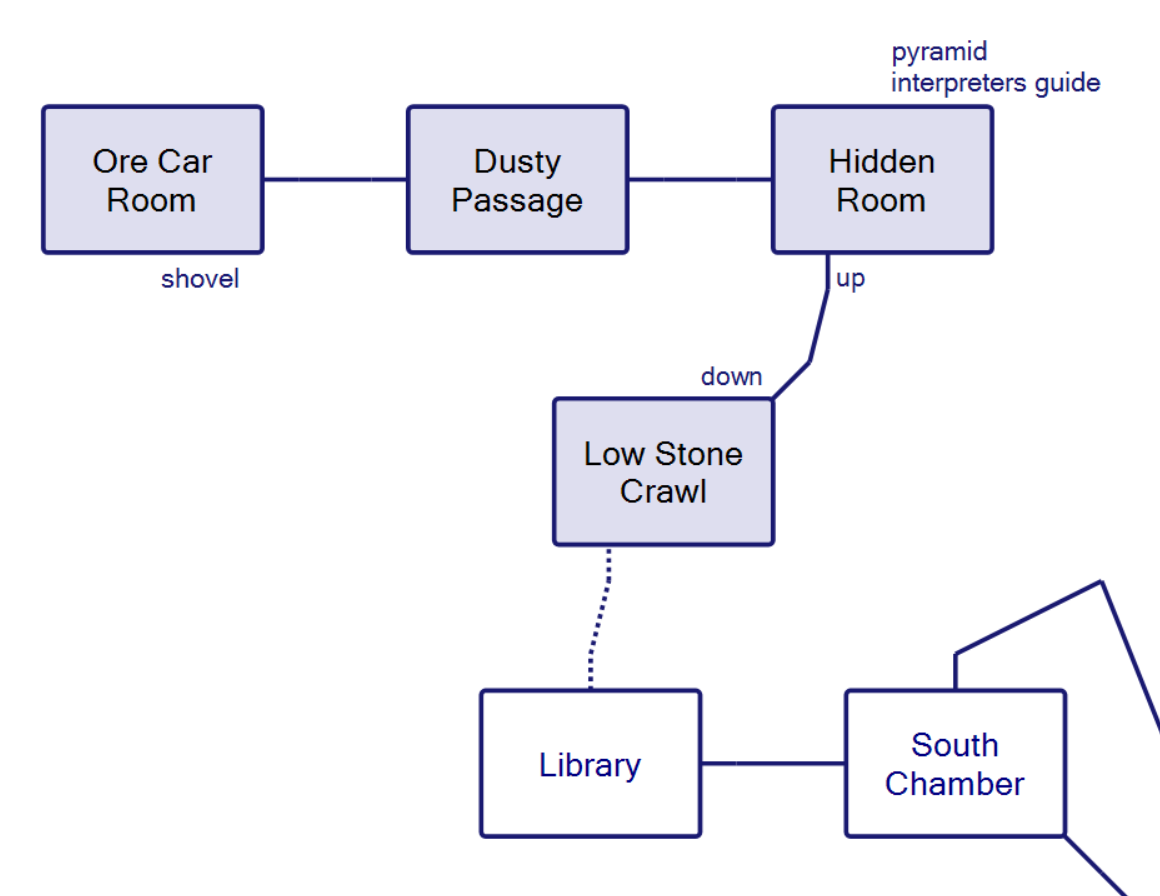
Finally there’s the basement. You need both the flashlight from the starting floor and the batteries from the top floor to explore; while holding both you can then use the syntax LIGHT ON or LIGHT OFF. (I tried INSERT BATTERIES, FIX BATTERIES, etc. first; they just need to be held along with the flashlight.)

The dirt floor east of the freezer will come into play later.

While there’s a BAG OF GOLD down at a TORTURE ROOM with a SET OF STOCKS, the other two objects (wrinkled parchment, can of bug spray) are both guarded.

to summarize, we have…

  • A vampire guarding a knife
  • An insane monk guarding a ming vase
  • A leopard guarding a sorcerer’s handbook
  • A protoplasmic blob guarding a parchment
  • A savage beast guarding a can of bug spray

…with a banjo, a flashlight with batteries, and a hairbrush as our only real tools. All three of them have pairings with the foes listed. Two of the pairings kind of make sense, one of them ramps up to nonsense.

The book left behind provides some magic words.

We’ll worry about those momentarily. For the second pairing, the banjo is enough to calm the “savage beast” (which at least is explicitly described that way to get the cliche phrase; I’m not used to thinking at the level of individual word choice with a tapemag game, that’d be more expected in something pun-heavy like Quondam).

That bug spray you get from the beast then goes to the protoplasmic blob. The parchment then left behind is the second part of the book (letting you know the magic words get used in the telephone booth, living room, and dining room).

Again, we’ll save dealing with the magic words for a little bit later, as let’s take out the last obstacles (the vampire and monk). The vampire takedown is the one that doesn’t make sense.

I guess it’s a sunlight-providing flashlight? Or maybe the vampire has some alternate lore? (The problem with using the “fan fiction shortcut” as I’ve called it is that there’s enough fan fiction universes it can be hard to tell which one the game is in.) You can then KILL MONK while holding the knife at the monk.

The monk reappeared for me in the basement elevator. It’s random, and it’s only a problem if he reappears somewhere where there’s an item, and then like ADV.CAVES — which had a kitten that scared a dragon — you have to re-do a puzzle solve.

Now it’s time for the magic! The words were ABRACADABRA, SHAZAAM, SEERSUCKER, and UGABOON, and the locations were TELEPHONE BOOTH, LIVING ROOM, and DINING ROOM. There is no particular logic which goes where; if you get one wrong you will be “disoriented” and get teleported to a different room, but it won’t end the game or anything like that.

There might be some random assignment, but for me, SEERSUCKER in the living room gave me a dime…

…and from there I was not able to get anything else to happen in any of the telephone booths or in the dining room. I started to get worried enough to check the walkthrough by Dale Dobson in case the bugs were not just in the Tandy 100 port.

The walkthrough mentions getting a leather glove in the basement phone booth somehow. I tried on a different save state and it worked (SEERSUCKER again); it seems to work and not work at random. Dale’s next step is to hack the inventory to give himself a shovel, and after enough fiddling I am able to report that the folks at Chromasette really should have tested the game to the end before publishing it. Dale’s playthrough is pure chaos and arguably is the buggiest I’ve ever seen in a published game. For example, holding the dime is supposed to cause teleportation with the telephone booths (I think I got it to happen once by accident, but otherwise I never got anything to trigger). Letting Dale take over:

What’s going on with the telephone booth rooms? They seem a lot more stable since I restarted. Do they react to having the dime in inventory? Yes! Now they start teleporting us randomly around again. But while the design intends for it to be possible to reach a “secret” fourth telephone booth in a separate section of the third floor we can’t otherwise reach, it’s nearly impossible for this to happen given the random number algorithm used in line 7. This can be patched imperfectly by changing the code to randomly pick a number between 0 and 5, instead of 0 and 4; the odds of it being greater than or equal to 4 are much better now. (After the fact, I realize that multiplying the random number by 4.999 would prevent a bad value of 5 from coming up without substantially altering the odds of it being 4.)

The whole thing is worth a read, but for my purposes I swerved over to Jim Gerrie’s version of the game. I also swapped my screen colors to be white on black just to change things up (and to be able to tell the two versions of the game apart).

I proceeded to try to speedrun up to the point I was, although I got foiled a little by a.) the map being slightly different (Gerrie removed some of the “wraparound” exits) and b.) the presence of the glove on the first floor, the one I previously got via magic word.

This is how I found out “the imposter” can be something other than a hairbrush. The idea is that some item in the house chosen at random has a duplicate somewhere, and that item is the imposter; since I already had the game mapped out I could simply note down if an item was in a place where it wasn’t supposed to be, but that wouldn’t have been as doable the first time around. (That is, I could map everything and find the duplicate, but as far as I can tell there’s no intrinsic way to tell which one of the duplicates isn’t real!)

On a reboot I found the wooden box here, when the regular wooden box is in the starting room with the locked door.

Proceeding through again, I got the dime, and tried taking it to the telephone booth, where this time I was teleported to a new area. (This is dark, so you need the flashlight again.)

The dry ice needs the glove (the one appearing from magic word, not the imposter-glove that kills you); a werewolf guards a pillow…

The werewolf really needs that 800 thread count.

…and you can nab a shovel in a room with a mainframe.

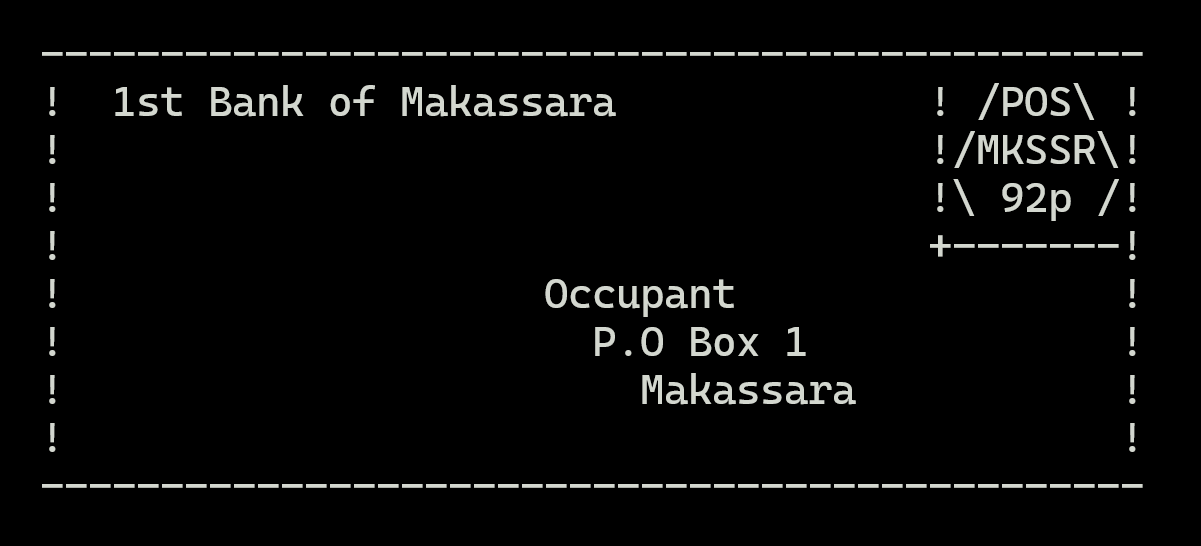
The mainframe is oddly specific and possibly a clue about the author’s background; I haven’t found anything more than the name and address.

I wasn’t sure how to deal with the werewolf, but I figured the shovel needed to go back to the basement and the dirt floor.

You have to dig twice (as is the grand old tradition), unearthing a rusty key and some garlic. This took care of my last two obstacles, the front door of the house and the werewolf. (I mean, I normally would use garlic on the vampire, but the vampire already was driven away by a flashlight.)

It’s not quite trivial to get to the end; the logistics are irritating, and there’s enough random aspects it’s not hard to end up having your flashlight run out of power. (This is true even though Jim Gerrie bumped up the number of turns it lasted!) I mentioned earlier how the monk moved around; I later found myself wanting to get the leather glove (magic word in the basement phonebooth, same as before, but a random magic word) and found two of the house’s critters now had moved in.

I had to get the banjo and the hairbrush in order to get the glove. What makes this even “better” is that if you drop an item outside, it disappears, so it is quite easy to have your game softlocked at this point.

While dealing with these annoyances, I had taken what I thought were all the objects, but I guess not, because I grabbed the “imposter” box and died!

I gave it all one more try from the top, this time trying to avoid disturbing any of the enemies until I absolutely had to (you can use the magic words without finding the book/parchment first) but still found myself teleporting from a lit telephone booth into a dark one and–

I’m out. I’m pretty sure I got the full experience, and again, both Dale’s account and Jim’s bugfix post are worth reading.

Now the 3rd floor phone booth will always transfer you to another phone booth, even without having the dime, so you can’t get trapped on the 3rd floor before getting the dime. This can happen if you get there by discovering and testing out the magical words, which can zap you to random rooms. Text adventures shouldn’t just be about meticulously recreating movement patterns learned after continuous arbitrary failures. They should be about figuring out clues and solving puzzles while exploring.

Coming up: what is hopefully a less buggy CoCo game. At least this one the editor didn’t make the grand announcement they didn’t beat the game before publishing it.

Friday, 30. January 2026

The People's Republic of Interactive Fiction

January 2026 Post Mortem

The People’s Republic of Interactive Fiction convened on Monday, Wednesday, January 21, 2026 over Zoom. Mike Stage, Matthew Griffin, Doug Orleans, Hugh, Michael Hilborn, anjchang, Stephen Eric Jablonski (with special guest Milo) , welcomed newcomers John Domenico (JD) Calvelli, Allyson and Vince Kotchian. Warning: What follows is probably not proper English, but just a log of […]

The People’s Republic of Interactive Fiction convened on Monday, Wednesday, January 21, 2026 over Zoom. Mike Stage, Matthew Griffin, Doug Orleans, Hugh, Michael Hilborn, anjchang, Stephen Eric Jablonski (with special guest Milo) , welcomed newcomers John Domenico (JD) Calvelli, Allyson and Vince Kotchian. Warning: What follows is probably not proper English, but just a log of notes from the meeting to jog people’s memories.

Topics Discussed

Narrascope 2026

  • JD current Narrascope conference, along with Matt Griffin (past chair)
  • Narrascope will be in Albany June 12-June 14th htps://narrascope.org/talks
  • there will be a hybrid component.
  • Jan 1st talk cycle begins. Submit your proposals by Jan 31. Reviews will go out in February, with results by March.
  • Discussion about the showcase, and the venue.
  • Questions feel free to email [email protected] – or if you’re looking for me specifically you can find JD on discord @baroswitch

Mentions about short games and puzzles

  • Doug mentioned attending the recent IAP mystery hunt. Also check out BAPHL for future puzzles.
  • The House in Fata Morgana visual novel. discussion about the length. The potential for fun short games turning into serialized games on a theme. Games with episodes, continuous chapters like Stardew Valley’s different mods.
  • Hugh is trying to make shorter and shorter IF. We talked about how short games evolve.
  • Allyson https://zophobas-morio.itch.io/ many small game jam projects.
  • Check out Infocom’s Nord and Bert Dad jokes (play here or here)
  • Hugh’s Beat Me U[ Scotty Game. Hugh discussed working on his dialogue system, see it in action!
  • Taper 16: For Good Measure is accepting submissions from for size-coded digital poetry works due Feb 3. Short works of digital poetry are always welcome.


Key & Compass Blog

New walkthroughs for January 2026

On Thursday, January 29, 2026, I published new walkthroughs for the games and stories listed below! Some of these were paid for by my wonderful patrons at Patreon. Please consider supporting me to make even more new walkthroughs for works of interactive fiction at Patreon and Ko-fi. Unknown Dimension (2025) by Garry Francis In this […]

On Thursday, January 29, 2026, I published new walkthroughs for the games and stories listed below! Some of these were paid for by my wonderful patrons at Patreon. Please consider supporting me to make even more new walkthroughs for works of interactive fiction at Patreon and Ko-fi.


Unknown Dimension (2025) by Garry Francis

In this sci-fi rescue adventure, you play as Amos Newton, an archaeology student. Your friend, Professor Baumbeker, rings you up. He babbles excitedly that the strange Incan sphere he found in Peru is showing him an unknown dimension. But in his lab, you only find the sphere. Not him. As you touch the sphere, you see a vision of the professor before you’re teleported to the dimension yourself. And it’s pitch dark.

This game is an adaptation of the 1987 Italian adventure Dimensione Sconosciuta by Bonaventura Di Bello, written using The Quill, then later rewritten as Amos Newton: Incubo. See credits for more details.

IFDB | My walkthrough and maps


All That Shimmers… (2025) by Andrew Apted

In this spooky adventure, it’s October 31st, and you’re a woman living in the small town of Dimpleford. Life was nice and simple until a witch started brewing something EVIL in the park. The ghost of your late grandmother urges you defeat this evil by midnight or else all freedom will be lost!

This game was an entry in PunyComp 2025 where it won 1st place overall, won 1st place for Puzzles, tied for the win for Playability on 8-bit computers, and 2nd place for Writing.

IFDB | My walkthrough and map


Kill Wizard (2025) by Dark Star

In this fantasy adventure, you play as a large muscular barbarian, returned to the Scavenger’s Den to meet your friend Darron from easten Shem. Unhappily, he bursts through the tavern door with a poisoned arrow in his chest and a bloodstained scroll signed by Belkor, a powerful necromancer who lives in a tower far to the northwest. Avenge Darron. Kill wizard.

This game was an entry in PunyComp 2025 where it took 3rd place overall; it also tied for 1st place in the Playability on 8-bit computers category, and took 4th place for both Writing and Puzzles.

IFDB | My walkthrough and map


Quirky Test (2025) by Andrew Schultz

This is a game about making spoonerisms of the people, places, and things you find while you search for the Rare-Thing-There Ring. Let Beery Thor welcome you to a land of Quickie Trips and Tricky Quips.

This game was written in Adventuron and was an entry in the Text Adventure Literacy Jam (TALP) of 2025 where it took 4th place.

IFDB | My walkthrough and map


Uptown 1 (2025) by Whit Walton

The prologue is in binary. You’ve taken the 1 train Uptown to West Harlem. When you enter the six-story walk-up, you feel a shock on the back of your neck. The coordinates were correct.

This game was an entry in the Bare Bones Jam 2025.

IFDB | My walkthrough and map


Ancient Treasure, Secret Spider (2025) by C.E.J. Pacian

In this fantasy adventure, you play as the cleverest and most beautiful fairy of the land, but you’re tethered to the Stranger by a silk thread. He, Trala, and Lind – an unlikely trio – journeyed to this cavernous chamber, but the last two are now holding off an endless horde of goblins at the gateway while the Stranger looks bewildered at the chamber’s contents. It’s time for you to take charge and find a way to the ancient treasure!

This game was written in Dialog and was an entry in Iron ChIF’s Pilot Episode where it was the co-winner in the Non-Human Language Device Battle.

IFDB | My walkthrough and map


greenskeep (2025) by xflorora

In this very short game, you play as someone underwater, certain you were doing something else before. Swim until you find the door to a beautiful kitchen, filled with greenery and a teapot.

This work was an entry in Bare-Bones Jam 2025.

IFDB | My walkthrough and map


The Organ Grinder’s Monkey (2025) by Garry Francis

In this short, pleasant, slice-of-life game, you play as the father of your three-year-old son, Tommy, who wants to go to the carnival. You don’t like frivolous spending, but you don’t want to be a bad father either. After consulting with the missus, you decide a trip to the carnival is worth the expense after all. The story begins with you and Tommy at the balloon vendor.

This game was an entry in PunyComp 2025, where it took 6th place overall, and 6th place in all other categories.

IFDB | My walkthrough and map

Thursday, 29. January 2026

Gold Machine

Moon; Missed

“I don’t promise to forget the mystery, but I know I’ll have a marvelous time.”–Nancy Drew Moonmist (1986) Play and read along with game and source files (Obsessively Complete Infocom Catalog)Packaging, copy protection, etc. (MoCAGH archive)Packaging, copy protection, etc. (Infodoc archive)Internet Archive query: “Moonmist”HTML InvisicluesArchived (z5) InvisicluesMap (Infodoc arch

“I don’t promise to forget the mystery, but I know I’ll have a marvelous time.”
–Nancy Drew

Moonmist (1986)

Play and read along with game and source files (Obsessively Complete Infocom Catalog)
Packaging, copy protection, etc. (MoCAGH archive)
Packaging, copy protection, etc. (Infodoc archive)
Internet Archive query: “Moonmist”
HTML Invisiclues
Archived (z5) Invisiclues
Map (Infodoc archive)

Original box for Moonmist. It shows a castle on a misty surface. Behind it, a large moon.

Opening Crawl

Moonmist
Infocom interactive fiction - a mystery story
Copyright (c) 1986 by Infocom, Inc. All rights reserved.
Moonmist is a trademark of Infocom, Inc.
Release number 9 / Serial number 861022

You drove west from London all day in your new little British sports car. Now at last you've arrived in the storied land of Cornwall.

Dusk has fallen as you pull up in front of Tresyllian Castle. A ghostly full moon is rising, and a tall iron gate between two pillars bars the way into the courtyard.

What would you like to do?
>‍

Don’t Look Back

As 1986 drew to a close, Infocom’s last commercial hit, Leather Goddesses of Phobos, was in the rear-view mirror. The next and final three years of Infocom’s existence as what we would call today a “studio” would be marked by escalating commercial decline. Later works also failed to leave the cultural footprint of early Infocom games, excepting only Amy Briggs’s Plundered Hearts (1987).

Why had people moved on? One ready answer is that Infocom’s unique value proposition had become a hindrance. In the early 1980s, Infocom had successfully set itself apart from mechanically and narratively crude arcade games with advertisements like the memorable “WOULD YOU SHELL OUT $1000 TO MATCH WITS WITH THIS” full-page magazine pitch featuring a primitive graphical image of a stick figure. Infocom games, with sometimes lush descriptions and varied, humorous action responses, had found a way to marry mechanics and narrative in a way that Zork’s competitors could not.

A 1980s advertisement for Infocom games featuring primitive graphics and the caption "would you shell out $1000 to match wits with this?"

1986 and 1987 were, more than half a decade later, a different epoch in the rapidly developing world of computer gaming. Infocom wasn’t competing with Adventure International or Namco’s PAC-MAN. They were competing with Nintendo’s The Legend of Zelda. Origin Systems’s landmark Ultima IV: The Quest of the Avatar was released in 1985 with two feelie booklets and a cloth map, a handsome package that would have eclipsed many gray box releases. It is remembered today for its narrative reactivity, a quality that had once arguably been Infocom’s greatest strength.

How could Infocom have, in some alternate timeline, competed in this new era of mechanically and narratively complex graphical games?

Falling Short

One answer would be for Infocom to do more of what it did well. Even beloved games like Zork I, Enchanter, and Planetfall have in-game objects for which there are little to no descriptive text. Many default response messages lack customization. A practice of what I’d call “narrative propulsion” could be developed to create compelling, plot-driven stories, as we see this working well in 1987’s Plundered Hearts.

There were some rather impassible obstacles. For one, a perceived commercial need to make games compatible with the Commodore 64—a system with a large install base in the United States–imposed hard technical limitations on how much content an Infocom game could contain. While Infocom could add conveniences like “undo” and “oops” to its parser, it couldn’t make richer experiences for their target demographic.

It’s worth noting that Infocom did attempt to make larger games with their “Interactive Fiction Plus” line, but, even if they are among my favorites, I have to admit that A Mind Forever Voyaging and Trinity were from the beginning destined for significance rather than success. It’s also worth noting that, despite their sizes, neither AMFV or Trinity managed to fully characterize or describe their game worlds. Many locations in AMFV feature one sentence descriptions, and the endgame of Trinity is constructed from radically sparse text.

I think Infocom learned the wrong lesson from the commercial failures of Interactive Fiction Plus, as those new, larger works retained the rhetorical structures of 128K games. Design-wise, I think it would have been better to go deep rather than wide, if that makes any sense. I don’t think what Infocom games needed in 1986 were more rooms and more puzzles.

That isn’t to say that nobody enjoyed more for more’s sake, but I think early games hit a sweet spot in term of scope. How long does one want to play a single parser game? There would have been a question of return on purchase price in those days, but most consumers seemed to agree that relatively tiny Zork I was worth the money. I’m not sure whether focusing on text and plot would have generated sales, but Infocom’s approach to scaling up did not work commercially.

A Castle in the Clouds

Perhaps no single game illuminates the exhausted rhetorical framework of 128K games more than Stu Galley’s and Jim Lawrence’s Moonmist, a title that sounds tremendously appealing in the abstract. Players are promised a Nancy Drew-style mystery in an atmospheric castle with a varied cast of personalities. Infocom’s marketing people seemed to appreciate the appeal of such an offering, as their The Status Line newsletter emphasized narrative intrigue and global reactivity:

You’ve spent the day driving southwest from London, from the small brick houses of the suburbs and the treeless plains of the South Downs to the Avon River and the picturesque villages of the Devon. Now, as evening draws near, you reach the storied land of Cornwall.

On either side, the moors stretch out, filled with heather and bogs. The fading light silhouettes craggy rocks on the horizon. At last you arrive at your destination: an ancient castle perched on the granite cliffs by the sea…

Moonmist also responds differently to male and female players. (See the Leather Goddesses of Phobos article for another example of this fine feature.) When you arrive at the castle gate at the start of the game, you’re asked for your title and full name. You can take advantage of your elegant surroundings by calling yourself “Baron Wilhelm” rather than plain old “Mr. Bill.”

From your title, the program may deduce your gender and respond accordingly throughout the story. If you’re a woman, you have a gown to put on for dinner. A man’s suitcase will contain a dinner jacket. Lord Jack will kiss a woman’s hand. If you’re a man, he’ll shake yours. And there’s another guest who may flirt with you. 

The promised atmosphere, narrative movement, and player customization are imperfectly realized, for reasons we will explore over the next two posts. For now, it is enough to say that the castle is large, empty and static.

Mixing It Up

I have yet to mention what many consider Moonmist’s most distinguishing feature: it includes four mysteries taking place in the same setting. At the game’s outset, the player can choose a color, and that choice will dictate which storyline plays out. This is a novel innovation that merits some appreciation. However, the consequence of this design choice is that we have yet again a title that forsakes depth for width. Instead of one trip through a mostly undescribed location, we are promised four.

>touch eye
The dragon's eye glows red. Evidently you just pushed a button. A voice comes from a hidden speaker. It says:
"Please announce yourself. State your title -- such as Lord or Lady, Sir or Dame, Mr. or Ms. -- and your first and last name."

>Ms. Fiona Lux
"Did you say your name is Ms. Fiona Lux?"

>yes
"And what is your favorite color, Ms. Lux?"

>Red
"Did you say your favorite color is red?"

>yes
"Jolly good! The spare bedroom is decorated in red! Please enter."
The red eye turns green, and the front gate creaks open.

It is fair, I think, to lay some of the blame for Moonmist’s utter lack of narrative urgency and mimetic vividness at the feet of Infocom’s self-imposed 128K ceiling, but as critics we must ask: why make a game that is, technically speaking, impossible to make well? Moonmist is not constructed within a framework that can feature a large and adequately-described castle with several people moving around in it, and it is quadruply incapable of telling four distinct stories.

In the course of my research, I encountered one internet conversant who characterized Moonmist as an “examining sim.” It is true that most gameplay involves examination as opposed to manipulation of objects. It is also true that examining things in Moonmist is usually unrewarding, as in-game descriptions do not assist in cultivating the sense of mystery promised by Infocom’s promotional materials. For instance, our protagonist has nothing to say about a “secret tape recorder.”

>examine recorder
You look over the secret tape recorder for a minute and find nothing suspicious -- for now.

Today, Moonmist is widely considered a lesser work. At the Interactive Fiction Database aggregator, it ranks just below Journey, a fact that might surprise the relatively few people who have played Journey. While aggregators do not capture such things, I imagine that Moonmist might rate very highly among games players wanted to like. Had it a narrower scope coupled with a deeper implementation, it might have better delivered on its promises. It is hard for me to play Moonmist without a pervasive sense of loss over what might have been.

Next

Next time, we will discuss the packaging and feelies that accompany Moonmist, paying special attention to the ways they might affect player experiences.


My So Called Interactive Fiction Life

Refactoring through our 123rd ADR

ADR stands for Architecture Decision Record. It's a critical aspect of producing well-designed code using GenAI (in my case I use Claude Code). The idea of an ADR is to capture something platform-sized. Something that improves the overall code base plus the developer and author experience. Hopefully, someone

ADR stands for Architecture Decision Record. It's a critical aspect of producing well-designed code using GenAI (in my case I use Claude Code). The idea of an ADR is to capture something platform-sized. Something that improves the overall code base plus the developer and author experience. Hopefully, someone besides myself might want to build a story using Sharpee.

In the latest batch of these documents we discovered a need for action interceptors, though the IF community knows these as Before, Instead, and After. Sharpee didn't know about them until yesterday.

On a weekly basis, I will read the code and if I see something fishy, I investigate. We had about 30 handlers for the Dungeon port and I smelled a rat. We looked at the patterns of these handlers and realized all but about 5 could be normalized into types of orchestrations. This includes formalizing what a Daemon is, added a declarative state machine, and migrating most of those 30 handlers to proper domain-oriented implementations. We also had an NPC implementation that was ad-hoc and we formalized that. In order to accommodate these new things, we built a plugin system so they get registered by the story when they're needed.

In a parallel session (I get bored watching Claude work, so I have Claude do other things in another terminal window) I asked Claude if we'd designed the system properly for separation of church and state. By this I meant, could we build a story runner and then package a story separately, The idea of anyone building an Electron or Tauri app seemed like asking too much. We'd already built a functional React app, so we moved it to package/zifmia (stolen from my client-server fyrevm days) and designed a stand-alone browser-based Sharpee story runner. This also let us make sure we were serializing everything (we were not) and designing what a story file is (zipped JavaScript with encrypted text so no cheating). The first story file produced is dungeo.sharpee and it's 172kb.

And of course we want to enable images and author-directed styling, so we enabled those as well. The author can tag any text with an image, location, border, and size, and Sharpee will unknowingly emit a second domain event with that information. The text service will see two events, the normal one and the styling one, and handle them accordingly. If the client is bare-bones, the styling is ignored. The author can also add assets like a global CSS style sheet or images.

As for the port of Dungeon, that's mostly done outside of walkthrough testing and we're currently through 7 sections of the game (torch/bank/maze/Egyptian room/exorcism/frigid river and rainbow). These walkthroughs have remained stable through every regression of the changes listed above.

I nearly asked Claude to over-engineer some of the daemons from Dungeon, but we pulled those back. They were fine readable code, but produced no benefit. Outside of that, Sharpee continues to march forward to a very near future 1.0 release.

I encourage people to look through the repo at https://github.com/chicagodave/sharpee/ and submit issues or feature requests or just visit https://sharpee.net/. The site is slightly out of date. I'll update it when we finish this last bit of zifmia work and update the npm packages too.

One request I'd like to implement is alternate language file/parser pairs. Might require some pair programming with someone savvy, but I don't think that would be a ton of work.


Renga in Blue

PRISM: The Atari Version

(Continued from my previous posts.) Curses, foiled again! The review that mentions PRISM (Creative Computing, May 1983) only lists the game for Apple II, and PRISM barely got any mentions later, so I didn’t even think about a second port until Atarimania asked in the comments about it. To be fair, that version is rare […]

(Continued from my previous posts.)

Curses, foiled again!

The review that mentions PRISM (Creative Computing, May 1983) only lists the game for Apple II, and PRISM barely got any mentions later, so I didn’t even think about a second port until Atarimania asked in the comments about it. To be fair, that version is rare enough it gets a perfect 10 from its Atarimania listing. Given there are three eBay listings of the Apple II version right now as of this writing (one, two, three) I think it likely the Atari version didn’t sell as well.

After some emulator issues I did get the game to work, and there are enough differences it’s worth downloading the set if you’re trying to work out PRISM in earnest. For now, I’m going to put all the art-screenshots (but not the text-screenshots, which you can find in the file if you want to delve for cryptograms or whatnot).

Just to make clear what I mean by differences, here’s the first screen of the Apple version…

…and the first of the Atari version.

PIMS are a different color than the R, which is not the case for the Apple II version. I had been thinking of the exact colors of the letters as highly significant, but maybe not. (Or the puzzle is broken on one platform but not the other!)

Here’s the remainder of the images, including a brand-new image for Atari (you’ll know it when you see it).

One last observation is the sound is different. The opening of the Atari version has a better melody, and there’s no “random music” going on at the XXXVI picture.

If nothing else, this clears up the squinting I was doing at some of the Apple II screens trying to see if the “noise” meant anything (that doesn’t even appear in the Atari shots). I don’t know what to think about the color changes. Look at the tree: it’s TRE + T now! If you consider just the blue letters, you get T from that page plus UNA from the last page. The only time red appears is the “R” at the start.

Coming up: some TRS-80 Color Computer games which should hopefully be less trouble!


The People's Republic of Interactive Fiction

October 2025 Post Mortem

The People’s Republic of Interactive Fiction convened on Monday, Oct. 27, 2025 over Zoom.  JP Tuttle, Hugh,  Matt Griffin, zarf, Josh Grams, Michael Stage attended. Note: Thank you to Michael Stage for taking the notes and photo (edited by Angela). A somewhat impromptu October meeting was held on the 27th, with several members able to attend: JP Tuttle,

The People’s Republic of Interactive Fiction convened on Monday, Oct. 27, 2025 over Zoom.  JP TuttleHugh,  Matt Griffinzarf, Josh Grams, Michael Stage attended. Note: Thank you to Michael Stage for taking the notes and photo (edited by Angela).

A somewhat impromptu October meeting was held on the 27th, with several members able to attend: JP Tuttle, Andrew Plotkin, Matthew Griffin, Hugh, Brad Wind, Joshua Grams, Henry Kay Cecchini, and Mike Stage.

A highlight of the meeting was an appearance by the author of Saltwrack, Henry Kay Cecchini (https://antemaion.itch.io/saltwrack or https://ifdb.org/viewgame?id=vg3uvt6bx9grqwtp). Henry joined us to discuss writing the game after seeing it mentioned in a previous meeting, as it was a favorite of some of our members for IF Comp 2025, where it came in 4th place (https://ifcomp.org/comp/2025). Henry also teased that a new version may be coming, and also a Spring Thing-type more visual game in a VN direction, involving a mad prophet and an underground labyrinth.

This segued us into discussing the merits of long and short games, and the practical need for short games in competitions.

For the second half of the meeting, Hugh showed off recent experiments using AI to help transform game outlines and story treatments into game code, and how he trained several different AIs to try to write in the language he was using. Sticking to pretty simple story outlines of fairy tales, and feeding in a kind of manual for the coding, Hugh told us about how Gemini, Claude and ChatGPT did making toy length games: full marks, some bugs, and hopeless, respectfully. We were surprised to hear that he could get compilable code out almost immediately in a number of cases, even for stories with some branching and variables.

The funny parts of course were where the AI was given freedom to generate it’s own versions of what, say, a “good”, “bad”, or “neutral” ending should be — and things like just not selling the cow and getting the magic beans for a beanstalk, or not selling the cow and just running out of money — were things the AI thought were fine, as we might expect. AI is not good at being witty or funny, either.

We finished up with some more discussion about AI and games, asking AI to play games as a way to test, and how that might differ from some of the mathematical ways of testing games, which there was a talk about at Narrascope (on Yarn Spinner) or which some of us had done ourselves writing our code to test (Zarf).

Honorable mentions:
In some context, Geoffrey Golden’s game “Fix Your Mother’s Printer” came up (https://geoffreygolden.itch.io/fymp), to which we thought a real-life inspired sequel “Fix Your Own Printer” is due.

Wednesday, 28. January 2026

Zarf Updates

Chronological order

Of course the first thing that happens is someone corrects my chronology. (Thanks dukdukgoos!) In my original post, I wrote "March: Zork 3; April: Starcross; May: Deadline." In fact Deadline was released before the other two. Back when I put ...

Of course the first thing that happens is someone corrects my chronology. (Thanks dukdukgoos!)

In my original post, I wrote "March: Zork 3; April: Starcross; May: Deadline." In fact Deadline was released before the other two.

Back when I put together my Infocom catalog index page, I copied off Paul David Doherty's venerable Infocom Fact Sheet. Except I think I copied the wrong section. Or something. Anyhow, I got them out of order -- and then failed to recheck my own list when I planned the Patreon.

To double-check, let's look at Margot Comstock Tommervik's review of Starcross:

If it takes a minimum of two instances to form a proposition, then Starcross, adventurous Infocom's first foray into science fiction and second departure from the dungeons of Zork, enables the proposition that this young company is one of remarkable versatility [...]. Deadline, the you-solve-it mystery, was, of course, instance one.

-- from Softalk Magazine, Nov 1982

Zork 3 was reviewed a couple of months previously, if you want to check that. In fact the archives of Softalk and Softline are a great record of the first half of Infocom's career; they reviewed the games obsessively until both magazines shut down in mid-1984.

(You can browse these Infocom articles and many more at the Invisiclues fan site.)

Those contemporary sources match the "Chronology" section of PDD's Fact Sheet:

  • Zork 1
  • Zork 2
  • Deadline
  • Zork 3
  • Starcross
  • Suspended
  • The Witness
  • Planetfall
  • Enchanter
  • Infidel
  • Sorcerer
  • Seastalker
  • ...and so on.

(Those are the "Folio" game releases. After Seastalker, Infocom adopted the now-more-famous "Grey Box" format.)

Interestingly, if you look at the earliest preserved serial number of each game -- excluding files tagged "alpha" or "beta" -- you get the same order. This means we probably have the first-shipped version of every game. Nice to know! You can also see that development on each game was usually locked the month before the ship date. Not bad for a release process that involved stuffing physical disks into physical boxes.

Anyhow, I'm keeping Zork 3 at the top of the Patreon schedule (March). I want to wrap up the trilogy right off the (Babe Flathead) bat. If everything moves forward as planned, I'll do Deadline in April, Starcross in May, and so on.

(This entry is cross-posted to the Patreon site.)

Tuesday, 27. January 2026

Renga in Blue

PRISM: The Clinging

(Continued from my previous posts.) This is my last post on PRISM for now; just like with Alkemstone, if something comes up worth posting about I may return. Some things to get out of the way first: I have a set of screenshots downloadable here and a video here (I’ve also embedded it below). This […]

(Continued from my previous posts.)

From John Blofeld’s I Ching (The Book of Changes).

This is my last post on PRISM for now; just like with Alkemstone, if something comes up worth posting about I may return.

Some things to get out of the way first: I have a set of screenshots downloadable here and a video here (I’ve also embedded it below). This is for anyone who wants to check the actual letters of the text or check frames of the color cycling as suggested in the comments. I haven’t had luck with either but I also haven’t pushed that hard.

There is sound but most of it is irritating. The one interesting part (in a treasure hunt sense) starts at 3:06 in the video where there is “music” which seems to be generated completely at random. That could of course signal some kind of coded information. (More on this later.)

I also had the question (brought up by Arthur O’Dwyer) what I thought the chances are the game is “broken”. I certainly don’t think it is intentionally so (this is a business software company that had four people make the game, they’d be risk-adverse about making a complete ruse) but it is still possible unfortunate typos slipped in which wreck something. For example, from the packaging that I quoted at the very start:

PRISM is an ISM Storydisk which tells the wonderous tale of the theft of the three ancient Keys of Color, and the adventures of the young boy who must seek them in the monstrous kingdom of Yolsva, Plane of Darkness. All is chaos, and the story contains many levels of hidden meaning through which the Keys may be found and reunited with the prism. When this occurs, and only then, can the mysterious and magical ending of PRISM unfold.

Yolsva is spelled Yolvsa in the game! This worries me both at a general level (if that’s a mistake, what else might be?) but also at the level of this specific name being odd enough it might be part of a clue. (Alkemstone had a typo in a clue where Jo was spelled Joe, so there’s precedent at least.)

I tried focusing my efforts on one page in particular, which feels quite central to the puzzle.

shamhat pointed out in the comments the part of the tree next to the double-fire symbol looks like a phoenix.

I spent a while researching the I Ching, or more specifically, the I Ching as understood by the authors in New York in 1982. There were a lot of “new age” style books from the 1970s so they could have been drawing from them.

From the 1970 book Secrets of the I Ching by Joseph Murphy, “one of the world’s best known authorities on helping people with mystic methods.”

The reason I say the particular slide I highlighted is central is that it has the double-fire symbol, also known (in the 1927 translation by Wilhelm) as The Clinging.

This hexagram is another double sign. The trigram Li means “to cling to something,” and also “brightness.” A dark line clings to two light lines, one above and one below— the image of an empty space between two strong lines, whereby the two strong lines are made bright. The trigram represents the middle daughter. The Creative has incorporated the central line of the Receptive, and thus Li develops. As an image, it is fire. Fire has no definite form but clings to the burning object and thus is bright. As water pours down from heaven, so fire flames up from the earth. While K’an means the soul shut within the body, Li stands for nature in its radiance.

Later Wilhelm writes:

What is dark clings to what is light and so enhances the brightness of the latter. A luminous thing giving out light must have within itself something that perseveres; otherwise it will in time burn itself out. Everything that gives light is dependent on something to which it clings, in order that it may continue to shine.

(There’s more to his text worth looking at; it’s the most likely translation our authors were using.)

A more scholarly breakdown from 1979 by Iulian K. Shchutskii (Researches on the I Ching, Princeton University Press) mentions a translation of “Supreme Success”. Many books vary — which is unfortunate for getting into the heads of our authors, who may have been referring to some lost hippie zine — but both “success” and “perseverance” seem fairly universal.

Another common interpretation I found (not universal, but common enough it’s a safe assumption the authors were thinking of it) is that I Ching symbols refer both to directions and to times of year.

From Blofeld.

Unfortunately, interpretations again vary, but it generally seems to be earth is east and fire is south (earth I’ve seen northeast, also, or even at “center”); the important part also is that north/south/east/west are simultaneously associated with the various equinoxes. That means we can use the shadow method to find a digging spot. While I could see getting lucky with hiding one item by using some very distinct landscape clue (like a particular rock at a cave over a patch of dirt) with three items I find “dig where the shadow’s tip is at the _____ equinox” to be much more likely.

Going back to that fallen tree, my guess for NOT A ROCK / NEVER HOT / NOT FRUIT / NEVER LOCKED is that the answers are drawn from I Ching elements.

Heaven, the Creative
Lake, the Joyous
Fire, the Clinging
Thunder, the Arousing
Wind, the Gentle (Wood)
Water, the Abysmal
Mountain, Keeping Still
Earth, the Receptive

1 THRU 3 OF EIGHT could also be referring to these eight in particular (it may be the I Ching elements are associated in the game with a color as well).

I tried fitting the mysterious letters CGKFKEA as well. I had less luck (even looking at Chinese transliteration). It could refer to the composer Cage, who was very much into the I Ching, and the “random music” I referenced earlier could actually be a clue to him. His Book of Changes (1951) was formed via aleatory methods directly from the Chinese text.

Special thanks to everyone who contributed theories; and of course you are welcome to continue! I did manage to do multiple updates on Alkemstone after I “finished” so it quite easily can happen here as well. Additional thanks to Jeremy Salkeld for advice on I Ching translations.

Monday, 26. January 2026

Zarf Updates

The Visible Zorker Project (and Patreon)

Announcing the Visible Zorker Project and Patreon. The plan: deconstruct every Infocom game, one per month, and make the source code explorable.

I posted Visible Zork 2 a few ago. What about Zork 3, you might ask? My post ended with a cryptic note: "...Let's say the chances are high. But I'll save that announcement for a bit."

(How do you keep a Wumpus in suspense?)

Here we go. Announcing! And inviting you to support!

A stylized dungeon door, swinging open. Golden light shines from beyond.

The Visible Zorker Project (and Patreon)

I intend to do all 31 of Infocom's text-mode adventures in Visible style. I intend to do one per month in chronological order. And I would like you to be part of this historic project. Yes -- you, in back, with the skirt and funny helmet.

And all the rest of you as well.

Visit the Patreon page to sign on.

Wait, all of the Infocom games?

All the plain-text ones. My "Visible" interpreter doesn't support Z-machine version 6, which means Zork Zero, Journey, Arthur, and Shogun are off the table. All the rest should be doable.

The "weird interface trick" games (Border Zone, Beyond Zork, Bureaucracy) get an asterisk. I may not be able to support those perfectly. Or the work may take longer than usual. But, hey, chronological order -- I won't have to worry about them for a couple of years.

(No, I'm not doing Fooblitzky. Hush you.)

Can you really do one per month?

Zork 2 was a feasibility test. I started that work on the evening of December 23rd; I released it on January 5th. In fact it was fully playable on Jan 2nd; I just gave it a couple of days for beta testing. So that's a week and a half.

(If you support this Patreon, you'll be in on the beta testing!)

Of course that was a holiday week, so I had time off from the day job. But also it was a holiday week, so I had to bake cookies and do jigsaw puzzles with family and friends and welcome in the new year, such as it is. So my time was somewhat divided either way.

If I can get a game up in ten days, I can commit to doing one per month without impacting my other time obligations. (The day job. Also baking cookies.)

It is possible I'll have to take a month off now and then. For example, NarraScope is in June (call for talks now open!) and that will eat some of my life. If I decide to skip a month, I'll pause the Patreon for that month.

I thought only the first three Zork games were open source.

That is true. But remember that I did the first Visible Zorker before Microsoft released them as open source. (Yes, people at Microsoft were aware of it.) This is research work that I think should be undertaken regardless of the legal status of the subject.

Anyhow, my understanding is that the Microsoft folks want to release all the Infocom games as open source. It's just a question of cranking it all through the lawyers. No idea how long that will take -- anywhere from a month to forever -- and I don't intend to wait on them.

What's the Patreon setup?

I'm keeping it simple.

$1/month: Supporter

You want to support the project, is all. Great! Any amount accepted.

You can join the Discord -- yes, there's a Discord -- for general social hangouts and IF discussion. Or not, if Discord isn't your thing.

$4/month: Participant

You get access to the Game of the Month section of the Discord. This is where we discuss the latest Visible Infocom game. (First up: Zork 3.) We will:

  • Play the game itself -- you get early Patreon access to the game's Visible page.
  • Discuss the game and its source code.
  • Group let's-play session via the Discord IF bot.
  • Look for bugs, secrets, and quirky game responses. (Bugs! We will find so many bugs.)

(All discoveries will be credited to their contributor in the game's commentary track.)

At the beginning of each month, you get access to a new Visible game. It won't be fully polished -- that's what the month of group Patreon access is for -- but it should be end-to-end playable.

$12/month: Contributor

You get access to the Game of the Month and the Game of Next Month, as I start to put that together.

  • Access to the super-early dev channel on the Discord.
  • Access to next month's repository from git init on. Play it when it doesn't even work yet!
  • Your name in lights. Well, everybody's name goes in the credits list, but Contributors are listed first.

$48/month: Fancy Contributor

This is really the same as Contributor. I just added a tier for people who are extra-enthusastic. Heck, you could go to $96 if you wanted.

Why are you charging money for this? Why not do it for free?

I've done a lot of IF work for free. Interactive fiction is a community practice, not an industry. Yes, it overlaps with the commercial game industry at many points (fractally!) but the core of it is done for love.

That said, this project is a substantial time investment. I said a year ago that I didn't plan to do any more "Visibles" after Zork 1. But I want to do more! I want to do a bunch! So I've plotted out a way to make the time and effort balance.

That said, all the games that I do will become publicly available two months after the Patreon community gets them. Patreon support gets you early access, not exclusive access.

As with the first two games, all of my Visible Zorker work will be open source under the MIT license.

(Just to avoid confusion: the Visible Zorker site and Patreon are my personal projects. They are not associated with the IF Archive or IFTF.)

What about other improvements to the Visible Zorker framework?

I'm sure there will be new features now and then. For example, I just added a "Grammar" tab -- it displays the ZIL parse table for each game. That's live for both Zork 1 and Zork 2.

I'll keep all Visible games, public and in-progress, updated with the latest improvements.

When does all this start?

The Patreon is open now. The Discord is open now.

I'll wait until February 14th (three weeks) to see how many people sign on. (That's your cue!) In the meantime, we can run Discord discussion and group plays of Zork 1 and Zork 2.

If we reach the $500/month goal by Feb 14th, I will start cranking on Zork 3. The aim will be to have a playable version ready for Patreon supporters on March 1st.

March will then be the month of Zork 3. Discord discussion; group plays; adding to the commentary; polish and bug fixes. Call it two weeks of beta and two weeks of early-access.

In April, we switch to Starcross Deadline. First-playable for Patreon Participants on April 1st; a month of discussion and group play. Thus we continue.

(Of course, Contributor-level supporters will see the games before the beginning of the month. That's the "even earlier access" tier.)

Again, the public and open-source release of each game will happen two months after the Patreon reveal. So Zork 3 goes live on May 1st for the world to appreciate. Hopefully Deadline goes public on June 1st, and so on.

What if you don't reach $500?

I have no idea how much interest this will draw. $500 per month is a bit arbitrary. But if we don't hit that mark by Feb 14th, I'll reevaluate the project and the schedule. Maybe the project doesn't fly. Maybe it will become one game every two months. I'll make an announcement; you'll have the opportunity to adjust your pledge at that time.

I'll do Zork 3 for March regardless, to ensure you get something for your first month's donation.

How DO you keep a Wumpus in suspense?

Trick question. They have sucker feet so they suspend themselves.

This is going to be fun!

Yeah, yeah it is.

Sunday, 25. January 2026

Renga in Blue

PRISM: How to Hide Something So Almost Nobody Finds It

(Continued from my previous posts on PRISM.) Nobody is easy. Almost nobody, that’s the tricky part. On the night of August 7th, 1979, I set off with Bamber Gascoigne, who was chosen to witness the burial. Once at the right spot, I cut a turf about ten inches square with my knife, then dug down […]

(Continued from my previous posts on PRISM.)

Nobody is easy. Almost nobody, that’s the tricky part.

On the night of August 7th, 1979, I set off with Bamber Gascoigne, who was chosen to witness the burial. Once at the right spot, I cut a turf about ten inches square with my knife, then dug down until I’d made a hole to the depth of my elbow. There was a moment of panic when my trowel hit rock, but it turned out to be just a small stone. In went the pot with the gold, then the earth and the turf. I watered the spot to encourage the grass to grow again. As Bamber and I shook hands over the burial ground, the moon came out from behind a cloud and, I like to think, shone down a blessing on us.

— From Masquerade, The Complete Book With the Answer Explained

The grand “thousands (or or tens of thousands, or more) participants / only one winner” treasure hunt seems particularly daunting to manage if it is meant to go over a large chunk of time. It is unclear if Masquerade’s multi-year span was accidental or intentional. Certainly, when Williams designed the puzzles and hid his hare, he fretted over the puzzle being too simple, as explained by the witness Bamber Gascoigne:

Kit had explained to me the basis of his puzzle, but even with that privileged information I was unable to make it work out. The cause of my growing uneasiness was the thought that if it was in fact impossibly difficult, then I was the only person in the world in a position to form that opinion. Kit considered it very possible, even perhaps dangerously easy, because he had invented it.

The game had the right density of red herrings to baffle the public; more than “he had invented it”, I think the reason Williams thought the puzzle was easy is he knew exactly which elements were red herrings. The excess of extra text and riddles (including hiding a hare in every picture) made it easy to project almost any answer whatsoever.

They are far more complex than anything I had imagined, yet they fit the book. It’s a scientific principle that if you want something to work badly enough, you organize the facts so that it does. I watch people allowing themselves to be twisted round and round. In the long run, solving the book is a matter of trial and error.

— Kit Williams quoted in The New York Times, The Legend of the Golden Hare, November 15, 1981, while the hare was still buried

One issue (which applies also to Alkemstone and PRISM) is that the puzzle requires indicating an exact spot. This was long before public GPS use. Even getting somewhere in the ballpark isn’t good enough; a small field is too hard to dig without more information. Williams managed this (possibly with incorrect measurements) by using a particular day and a particular time and the exact position of a shadow. Based on what we know about Alkemstone, I’m guessing a similar idea. With PRISM, I’m not sure; PRISM’s job is made more onerous by having to give the location of three items.

People have been using clues to guess states (and I’ll get to that) but somewhere, somehow, there has to be something at a numerical level. Perhaps it is the shadow trick again (given the product’s theme of light). Is there some other way to do it?

Or it could be the puzzle is broken by unclear directions, like the stereotypical pirate map “forward 50 paces, then right 60 paces” which isn’t very exact at all. I had at least vague concern that this screen might be like that, although there’s a theory from the comments I’ll get to later that treats the puzzle as wordplay.

All this relates to another issue: how close are the keys to each other? There is no rule that says they need to be spread out across different states, and in the review I referenced last week the author asked specifically that question (with no answer received). I could see some particular landmark being marked which then gets re-used three times for three different shadow points, for instance.

I think part of the reason Pimania had a superior puzzle from what we’ve seen so far is it did not require an exact location; it was able to use fairly general symbolic language without getting into the nitty gritty of exactly how many meters forward from spot X to get.

I bring all this up not just because theorizing is part of the point of this blog, but also because it may help in forming a solution. Thinking backwards, we know three exact locations have to be clued somehow. (Maybe in a flawed way, but even the most self-deluded of puzzle-setters would know they can’t just indicate a particular park somewhere.) There’s not a lot of emphasis on time of year (like there was on Alkemstone — which is why I suspect that game was using the shadow method); if a game was not using the shadow method, is there some other compact way to represent three entirely different digging spots?

I note that the majority of the “twisted round and round” answers that I’ve seen referenced for Masquerade fail the criterion of giving an actual spot to dig. (From the NYT article: “Among the most common ‘solutions’ Williams receives are: Stonehenge, the Greenwich Observatory and the Hill of Tara in County Meath, Ireland.” I suppose you could claim you meant the “high spot” of a hill but even that would tend to be ambiguous. To be fair, some of these were sent to the author trying to go “fishing” for information with the hope they’d get feedback that they had the right area, just they needed to refine down to an exact spot.

Swerving back to looking at the actual content, we had various theories trying to interpret the different side messages. Regarding that “In at 7…” message, John Myers had a promising theory:

The word “rerouting” has “out” at position 4, “in” at 7 and means “forward” (as in to forward mail) and is slightly more than 8 letters. No idea how this fits into the puzzle if it is correct though.

That is, the word being built is _ _ _ O U T I N _ like a cryptic crossword clue. I’m not sure where to go with this information, though; it might suggest US map routes, but not what to do with them. Syracuse is incidentally at the intersection of I81 and I90:

Aula and Aspeon tried to interpret messages as US states:

Also, “TWO OF ONE” comes before “ONE OF TWO” because the only always-sensible reading order is left/top/right/bottom. This makes the text rhyme at the halfway point and end (here TWO/BLUE) with the only exception on the page with “1 THRU 3 / OF EIGHT”. There are several states with eight-letter names, but only in “Oklahoma” all of the first three letters can point to other states; O for Ohio, K for Kansas (34th state, so XXXIV) and L for Louisiana.

“IN AT 7 / OUT AT FOUR / FORWARD 8 / AND SLIGHTLY MORE” is probably cluing South Carolina in a similar way: letters 6-7 of Carolina are IN, letters 2-4 of South are OUT, letters 6-8 of the full name is CAR, and there are a few leftover letters. (S/H/OL/A)

In more expansion of the “maybe some clues indicate states” idea, Rob suggested that “Up north / Lines meet / Down south / Fates greet” was in reference to some kind of state lines (like the “four corners” area around Arizona/New Mexico/Colorado/Utah) and Matt W. though perhaps “Fates greet” could be Truth and Consequences, New Mexico.

Morpheus Kitami tried to organize the letters based on color (using, as Aula points out, the proper order of starting left and going clockwise):

Red: PIMSRNESUHRTTENAREGVIXXX

Blue: RLACENONESRNENUR

Green: GCKFKAEUASVYOLA

Purple: APOLARTFLIE

With anagrams of

Red: PRISM HUES GRANE XXXVI (NRTTE extra)

Blue: CLEAR ONE RUNNERS (N extra)

Green: YOLSVA

Purple: POLAR LIFE

(The green is excluding the “GCKFKEA” text.)

He also highlighted what he calls an “elevator”…

…although I admit I just thought of it as a door with the text over it. Intuitively, I do think there’s a fair chance this is a real clue, perhaps indicating whatever we find will have “west” amount indicated first and then “north” amount after. Or perhaps the up-arrow can be interpreted as a mountain, because there’s a few I Ching symbols scattered throughout, all of them referring to Gen (Mountain).

There’s a similar symbol at the fallen-tree picture. (It could be two versions of Li or Fire stacked on top of each other.)

There’s enough mountain references in the art I got suspicious, but other than my guesswork going nowhere, it was failing the basic question of how do you indicate three exact spots? One could imagine very expensive surveying gear somehow being placed at particular heights but it seems like you’d need to still convey a large amount of information in order to mark where X is.

Even the “mystery anagram” page which is fairly sparse has part of a mountain in the picture.

I’m definitely going to be making at least one more post — I am determined to organize the information into some sort of (likely spectacularly wrong) theory so I can at least encapsulate what the authors may have been up to. More ideas in general are of course welcome.

In the meantime, anyone with a theory on NOT A ROCK, NEVER HOT, NOT FRUIT, NEVER LOCKED? I might throw this one out to social media because it seems plausibly standalone. It doesn’t work like a “riddle” since there are plenty of things that fulfill all four categories, but is there something themed around the contents of PRISM that would work best? Or maybe a set of five things (or more), where four out of the things are excluded neatly by the “rock/hot/fruit/locked” phrases?

Friday, 23. January 2026

Interactive Fiction – The Digital Antiquarian

Omikron: The Nomad Soul

The idea of being in the body of a guy and making love to his wife — when she believes you’re her husband, even though you’re not — was a very strange position to be in. That’s exactly the kind of thing I try to explore in all my games today. — David Cage, speaking […]

The idea of being in the body of a guy and making love to his wife — when she believes you’re her husband, even though you’re not — was a very strange position to be in. That’s exactly the kind of thing I try to explore in all my games today.

— David Cage, speaking from the Department of WTF

The French videogame auteur David Cage has been polarizing critics and gamers for more than a quarter-century with his oddly retro-futurist vision of the medium. He believes that games need to cease prioritizing “action” at the expense of “emotion,” a task which they can best accomplish, according to him, by embracing the aesthetics, techniques, and thematic concerns of cinema. You could lift a sentence or a paragraph from many a post-millennial David Cage interview, drop it into an article from the “interactive movie” boom of the mid-1990s, and no one would notice the difference. The interactive movie is as debatable a proposition today as it was back then; still more debatable in many cases has been Cage’s execution of it. Still, he must be doing something right: he’s been able to keep his studio Quantic Dream alive all these years, making big-budget story-focused single-player games in an industry which hasn’t always been terribly friendly toward such things.

Cage’s very first and least-played game was known as simply The Nomad Soul in Europe, as Omikron: The Nomad Soul in North America; I’ll go with the latter name here, because that’s the one under which you can still find it on digital storefronts today. Released in 1999, it’s both typical and atypical of his later oeuvre. We see the same emphasis on story, the same cinematic sensibility, the same determination to eliminate conventional failure states, even the same granular obsessions with noirish law enforcement, the transmigration of souls, and, well, Blade Runner. But it’s uniquely ambitious in its gameplay, despite having been made for far less money than any other David Cage production. It’s a combination of Beneath a Steel Sky with Tomb Raider with Mortal Kombat with Quake, with a soundtrack provided by David Bowie. If you’re a rambunctious thirteen-year-old, like our old friends Ian and Nigel, you might be thinking that that sounds awesome. If you’re older and wiser, the alarm bells are probably already ringing in your head. Such cynicism is sadly warranted; no jack of all trades has ever mastered fewer of them than Omikron.


David Cage was born in 1969 as David de Gruttola, in the Alsatian border town of Mulhouse, a hop and a skip away from both Germany and Switzerland. He discovered that he had a talent for music at an early age. By the time he was fifteen, he could play piano, guitar, bass, and drums, and had started doing session gigs for studios as far away as Paris. He moved to the City of Light as soon as he finished school. By saving his earnings as a session musician, he was eventually able to buy an existing music studio there that went under the name of Totem. A competent composer as well as instrumentalist, he provided jingles for television commercials and the like. These kinds of ultra-commoditized music productions were rapidly computerizing by the end of the 1980s; it was much cheaper and faster to knock out a simple tune with a bank of keyboards and a MIDI controller than it was to hire a whole band to come in or to overdub the parts one by one on “real” instruments. Thus Totem became David de Gruttola’s entrée into the world of digital technology.

Totem also brought Gruttola into the orbit of the French games industry for the first time. He provided music and/or sound for five games between 1994 and 1996: Super DanyTimecopCheese Cat-astropheVersailles 1685, and Hardline. Roll call of mediocrity though this list may be, it awakened a passion in him. By now in the second half of his twenties, he was still very young by most standards, but old enough to realize that he would never be more than a competent musician or composer. Games, though… games might be another story. Never one to shrink unduly from the grandiose view of himself and his art, he would describe his feelings in this way a decade later:

I remember how many possibilities suddenly opened up because of this new technology. I saw it as a new means of expression, where the world could be pushed to its limits. It was my way of exploring new horizons. I felt like a pioneer filmmaker at the start of the twentieth century: grappling with basic technology, but also being aware that there is everything left to invent — in particular, a new language that is both narrative and visual.

Thus inspired, Gruttola wrote a script of 200 to 250 pages, about a gamer who gets sucked through the monitor into an alternative universe, winding up in a futuristic dystopian city known as Omikron. The script was “naïve but sincere,” he says. “I was dreaming of a game with an open-world city where I could go wherever I wanted, meet anybody, use vehicles, fight, and transfer my soul into another body.” (Ian and Nigel would surely have approved…)

Being neither a programmer nor a visual artist himself, he convinced a handful of friends to help him out. They first tried to implement Omikron on a Sony PlayStation, only to think better of it and turn it into a Windows game instead. Late in 1996, more excited than ever, Gruttola offered his friends a contract: he would pay them to work on the game exclusively for the next six months, using the money he had made from his music business. At the end of that time, they ought to have a decent demo to shop around to publishers. If they could land one, they would be off to the races. If they couldn’t, they would put their ludic dreams away and go back to their old lives. Five of the friends agreed.

So, they made a 3D engine from scratch, then made a first pass at their Blade Runner-like city. “The demo presented an open world,” recalls Oliver Demangel, who left a position at Ubisoft to take a chance with Gruttola. “You could basically walk around in a city and have some limited interaction with the environment around you.” With the demo in hand and his six-month deadline about to expire, Gruttola started calling every publisher in Europe. Or rather “David Cage” did: realizing that his surname didn’t exactly roll off the tongue, he created the nom-de-plume by appropriating the last name of Johnny Cage, his favorite fighter from Mortal Kombat.

The British publisher Eidos, soaring at the time on the wings of Tomb Raider, invited the freshly rechristened game designer to come out to London. Cage flew back to Paris two days later with a signed development contract in hand. On May 2, 1997, Totem morphed into Quantic Dream, a games rather than a music studio. Over the following month, Cage hired another 35 people to join the five friends he had started out with and help them make Omikron: The Nomad Soul.

Games were entering a new era of mass-market cultural relevance during this period. On the other side of the English Channel, Lara Croft, the heroine of Tomb Raider, had become as much an icon of Cool Britannia as the Spice Girls, giving interviews with journalists and lending her bodacious body to glossy magazine covers, undaunted by her ultimate lack of a corporeal form. Thus when David Cage suggested looking for an established pop act to perhaps lend some music to his game, Eidos was immediately receptive to the idea. The list of possibilities that Cage and his mates provided included such contemporary hipster favorites as Björk, Massive Attack, and Archive. And it also included one name from an earlier generation: David Bowie. Bowie proved the only one to return Eidos’s call. He agreed to come to a meeting in London to hear the pitch.

David Bowie bridges the generations with Trent Reznor of Nine Inch Nails.

More than a decade removed from the peak of his commercial success, and still further removed from the unimpeachable, genre-bending run of 1970s albums that will always be the beating heart of his musical legacy, the 1990s version of David Bowie had settled, seemingly comfortably enough, into the role of Britpop’s cool uncle. He went on tour with the likes of Nine Inch Nails and Morrissey and released new albums every other year or so that cautiously incorporated the latest sounds. If the catchy hooks and spark of spontaneity — not to mention the radio play and record sales — weren’t quite there anymore, he did deserve credit for refusing to become a nostalgia act in the way of so many of his peers.

But almost more relevant than Bowie’s current music when it came to Omikron was his deep-seated fascination with the new digital society he saw springing into being around him. He had started to use a computer himself only a few years before: in 1993, when his 22-year-old son Duncan gave him an Apple Macintosh. At first, he used it mostly for playing around with graphics, but he soon found his way onto the Internet for the first time. This digital frontier struck him as a revelation. He became so addicted to surfing the Web that he had to join a support group. He seemed to understand what was coming in a way that few other technologists — never mind rock stars — could match. He became the first prominent musician to make his own website and to use it to engage directly with his fans, the first to debut a new song and its accompanying video on the Internet, the first to co-write a song with a lucky online follower. Displaying a head for business that had always been one of his more underrated qualities, he started charging fans a subscription fee for content at a time when few people other than porn purveyors were bothering to even try to make money online. By the time he took the meeting with Eidos and Quantic Dream, he was in the process of setting up BowieNet, his own Internet service provider. (Yes, really!) He had also just floated his “Bowie Bonds,” by which means his fans could help him to raise the $55 million he needed to buy his back catalog, remaster it, and re-release it as a set of deluxe CDs. From social networking to crowd-sourcing, Bowie was clearly well ahead of the curve. “I don’t even think we’ve seen the tip of the iceberg,” he would say in 2000 in a much-quoted television interview. “I think the potential of what the Internet is going to do, both good and bad, is unimaginable. I think we’re on the cusp of something exhilarating and terrifying.” Subsequent history has resoundingly vindicated him, although perhaps not always in the ways that his inner digital utopianist might have preferred.

One thing David Bowie was not, however, was a gamer. He took the meeting about Omikron largely at the behest of his son Duncan, who was. He arrived at Eidos’s headquarters accompanied by said son; by his wife, a former supermodel who went by the name of simply Iman; and by his principal musical collaborator of the past decade, the guitarist Reeves Gabrels. They all sat politely but noncommittally while a very nervous group of game developers told them all about Omikron. “Okay, then, what do you need from me?” asked Bowie when the presentation was over. An unusually abashed David Cage said that, at a minimum, they were hoping to license a song or two for the game — maybe the Cold War-era anthem “‘Heroes'” or, failing that, the more recent “Strangers When We Meet.” But in the end, Bowie could be as involved as he wanted to be.

It turned out that he wanted to be quite involved indeed. Over the next couple of hours, Quantic Dream got all they could have dreamed of and then some. Carried away on a wave of enthusiasm, Bowie and Gabrels promised to write and record a whole new album to serve as the soundtrack to the game. And Bowie said he was willing to appear in it personally in motion-captured form. Maybe he and Gabrels could even perform a virtual concert inside the virtual world. Heads were spinning when Bowie and his entourage finally left the building that day.

Iman and David Bowie both appear in Omikron in motion-captured form.

As promised, Bowie, Iman, and Gabrels came to Paris for a couple of weeks, where they participated in motion-capture and voice-acting sessions and saw and heard more about the world and story of Omikron. Then they went away again; Quantic Dream heard nothing whatsoever from them for months, which made everyone there extremely nervous. But then they popped up again to deliver the finished music — no fewer than ten original songs — right on time, one year almost to the day after they had agreed to the project.

The same tracks were released on September 21, 1999, as hours…, David Bowie’s 23rd studio album. Critics greeted it with some warmth, calling it a welcome return to more conventional songcraft after several albums that had been more electronica than rock. The connection of the music to the not-yet-released game was curiously elided; few reviewers of the album even seemed to realize that it was supposed to be a soundtrack, the first of its type. That same autumn, the veteran progressive-rock group Yes would debut a single original song written for the North American game Homeworld, but Bowie’s contribution to Omikron was on another order of magnitude entirely.

The 1999 David Bowie album hours… was, technically speaking, the soundtrack to Omikron: The Nomad Soul, but you’d have a hard time divining that from looking at it.

Omikron itself appeared about six weeks later. Absolutely no game critic missed the David Bowie connection, which became the lede of every review, thus indicating that the cultural dynamic between games and pop music had perhaps not reached a state of equilibrium just yet. But despite the presence of Bowie, reviews of the game were mixed in Europe, downright harsh in North America. Computer Gaming World got off the best zinger against the game it dubbed Omikrud: “We could be coasters, just for one day.” The magazine went on to explain that “the concept of wrapping an adventure game around a David Bowie album is a cool one. The problem here is with the execution. And your own execution will look more and more desirable, the longer you attempt to play this game.” Rude these words may be, but in my experience they’re the truth.


But what if I don’t want to say yes?

Omikron boasts a striking and memorable opening. When you click the “New Game” button, a fellow dressed in a uniform that looks like a cross between Star Trek and T.J. Hooker pops onto the screen and starts talking directly to you, shattering the fourth wall like so much wet plaster. “My name is Kay’l,” he tells you. (His full name will prove to be Kay’l 669, because of course it is.) “I come from a universe parallel to yours. My world needs your help! You’re the only one who can save us!”

Kay’l wants you to transfer your soul into his body and journey with him back to his home dimension. “You must concentrate!” he hisses. To demonstrate how it’s done, Kay’l holds up his hands and doubles over like a constipated man on a toilet. “You’ve done it!” he then declares with some relief. “Now your soul occupies my body.” (If my soul occupies his body, why am I still sitting in front of my monitor watching him talk at me?) “This is the last time we’ll be able to speak together. Once you’ve crossed the breach, you’ll be on your own. I will take over my body when you leave the game and hold your place until you return.” Thus we learn that Omikron intends to go all-in all the time on diegesis. Lord help us.

You-as-Kay’l emerge in an urban alleyway, only to be set upon by a giant demon that seems as out of place here as you do. This infernal creature is about to make short work of you, thereby revealing a flaw in Kay’l’s master plan. Luckily, a police robot shows up at this juncture and scares away the demon, who apparently isn’t all that after all. “You have been the victim of a violent attack,” RoboCop helpfully informs you, seemingly not noticing that you’re dressed in the uniform of a police officer yourself. “Go home and re-hydrate yourself.”

Trying to take his advice, you fumble about for a while with the idiosyncratic and kind of idiotic controls and interface, and finally manage to locate Kay’l’s apartment. There you discover that he’s married, to a fetching woman whose closet is filled only with hot pants and halter tops. (In time, you will learn that this is true of almost all of the women who live in Omikron.) Seeming unconcerned by the fact that her husband has evidently suffered some sort of psychotic break, disappearing for three days and returning with his memory wiped clean, she lies down on the bed to await your ministrations. You lie down beside her; coitus ensues. Oh, my. Less than half an hour into the game, and you’ve already bonked your poor host’s wife. One wonders whether the fellow is inside his body with you watching the action, so to speak, and, if so, whether he’s beginning to regret fetching you out of the inter-dimensional ether.

Kay’l’s wife will later turn out to be a demon in disguise. I guess that makes it okay to have sex with her under false pretenses. And anyway, these people can do the nasty without having to take their clothes off, just like the characters in a Chris Roberts movie.

I do try to be fair, so let me say now that some things about this game are genuinely impressive. The urban environs qualify at first, especially when you consider that they run in a custom-coded 3D engine. It takes some time for the realization to set in that the city of Omikron is more a carefully curated collection of façades — like a Hollywood soundstage — than a believable community. But once it does, it becomes all too obvious that the people and cars you see aren’t actually going anywhere, even as the overuse of the same models and textures becomes difficult to ignore. There’s exactly one type of car to be seen, for example — and, paying tribute to Henry Ford, it seems to be available in exactly one color. Such infelicities notwithstanding, however, it’s still no mean feat that Quantic Dream pulled off here, a couple of years before Grand Theft Auto III. That you can suspend your disbelief even for a while is an achievement in itself in the context of the times.

Yet this is not a space teeming with interesting interactions and hidden nooks and crannies. With one notable exception, which I’ll get to later, very little that isn’t necessary to the linear main plot is implemented beyond a cursory level. The overarching design is that of a traditional adventure game, not a virtual open world at your beck and call. You learn from Kay’l’s wife — assuming you didn’t figure it out from his uniform — that he is a policeman in this world, on the hunt for a serial killer. (Someone is always a policeman on the hunt for a serial killer in David Cage games.) You have to run down a breadcrumb trail of clues, interviewing suspects and witnesses, collecting evidence, and solving puzzles. The sheer scale of the world is more of a hindrance than a benefit to this type of design, because of the sheer quantity of irrelevancies it throws in your face. By the time you get into the middle stages of the game, it’s becoming really, really hard to figure out where it wants you to go next amidst this generic urban sprawl. And by the same point, your little law-enforcement exercise has become a hunt for demons who are on the verge of destroying the entire multiverse, as you crash headlong into a bout of plot inflation that would shock a denizen of the Weimar Republic. The insane twists and turns the plot leads you through do nothing to help you figure out what the hell the game wants from you.

But I was trying to be kind, wasn’t I? In that spirit, let me note that there are forward-thinking aspects to the design. One of David Cage’s overriding concerns throughout his career has been the elimination of game-over failure states. If you get yourself killed here, the game will always find some excuse to bring you back to life. Unfortunately, the plot engine is littered with soft locks, whereby you can make forward progress impossible by doing or not doing something at the right or wrong moment. I assume that these were inadvertent, but that doesn’t make them any more excusable. This is one of several places where the game breaks an implicit contract it has made with its player. It strongly implies at the outset that you can wing it, that you’re expected to truly inhabit the role of a random Joe Earthling whose (nomad) soul has been sucked into this alternative dimension. But in actuality you have to meta-game like crazy to have a chance.

A save point.

The save system is a horror, a demonstration of all the ways that the diegetic approach can go wrong. You have to find save points in the world, then use one of a limited supply of “magic rings” you find lying around to access them. In addition to being an affront to busy adults who might not be able to play for an extra half-hour looking for the next save point — precisely the folks whom David Cage says games need to become better at attracting — this system is another great way to soft-lock yourself; use up your supply of magic rings and you’re screwed if you can’t find some more. There is a hint system of sorts built into the game, but it’s accessible only at the save points, and requires you to spend more magic rings to use it. In other words, the player who most needs a hint will be the least likely to have the resources to hand by which to get one. This is another running theme of Omikron: ideas that are progressive and player-friendly in an abstract sense, only to be implemented in a bizarrely regressive, player-hostile way. It bears all the telltale signs of a game that no one ever really tried to play before it was foisted on an unsuspecting public.

And then there are the places where Omikron suddenly decides to cease being an adventure game and become a beat-em-up, a first-person shooter, or a platformer. I hardly know how to describe just how jarring these transitions are, coming out of the blue with no warning whatsoever. You’ll be in a bar, chatting up the patrons for clues — and bam, you’re in shooter mode. You’ll be searching a locker room — and suddenly you’re playing Mortal Kombat against a dude in tighty-whities. These action modes play as if someone once told the people who made this game about Mortal Kombat and Quake and Tomb Raider, but said people have never actually experienced any of those genres for themselves.

I struggled mightily with the beat-em-up mode at first because I kept trying to play it like a real game of this type — watching my opponent, varying my attacks, trying to establish some sort of rhythm. Then a friend explained to me that you can win every fight just by picking one attack and pounding on that key like a hyperactive monkey, finesse and variety and rhythm be damned.

Alas, the FPS mode is a tougher nut to crack. The default controls are terrible, having nothing in common with any other shooter ever, but you can at least remap them. Sadly, the other problems have no similarly quick fix. Enemies can shoot you when they’re too far away for you to even see them; enemies can spawn out of nowhere right on top of you; your own movements are weirdly jerky, such that it’s hard to aim properly even in the best of circumstances. Just how ineptly is the FPS mode of Omikron implemented, you ask? So ineptly that you can’t even access your health packs during a fight. Again, it’s hard to believe that oversights like this one would have persisted if the developers had ever bothered to ask anyone at all to play their game before they stuck it in a box and shipped it.

The jumping sequences at least take place in the same interface paradigm as the adventure game, but the controls here are just as sloppy, enough to make Omikron the most infuriating platformer since Ultima VIII tarnished a proud legacy. And don’t even get me started on the swimming — your character is inexplicably buoyant, meaning you’re constantly battling to keep his head underwater rather than the opposite — or the excruciating number of times you’ll see the words “I don’t know what to do with that” flash across the screen because you aren’t standing just right in front of the elevator controls or the refrigerator or the vending machine. Even David Cage, a man not overly known for his modesty, confesses that “I wanted to mix different genres, but I wouldn’t say that we were 100-percent successful.” (What percentage successful would you say that you were, David?)

Then we have the writing, the one area where we might have expected Omikron to excel, based on the rhetoric surrounding it. It does not. The core premise, an invasion by demons of a city lifted straight out of Blade Runner, smacks more of adolescent fan fiction than the adult concerns David Cage yearns for games to learn to address. As I already noted, the plot grows steadily more incoherent as it unspools. Interesting, even disturbing elements do churn to the surface with reasonable frequency, but the script is bizarrely oblivious to them. As the game goes on, for instance, you acquire the ability to jump into other bodies than that of poor cuckolded Kay’l. Sometimes you have to sacrifice these bodies — murdering them from the point of view of the souls that call them home — in order to continue the story. The game never acknowledges that this is morally problematic, never so much as feints toward the notion of a greater good or ends justifying the means. This refusal of the game to address the deeper ramifications of its own fiction contributes as much as the half-realized city to giving the whole experience a shallow, plastic feel. Omikron brings up a lot of ideas, but seemingly only because David Cage thinks they sound cool; it has nothing to really say about anything.

Mind you, not having much of anything to say is by no means the kiss of death for a game; I’ve played and loved plenty of games with nothing in particular on their minds. But those games were, you know, fun in other ways. There’s very little fun to be had in Omikron. Everything is dismayingly literal; there isn’t a trace of humor or whimsy or poetry anywhere in the script. I found it to be one of the most oppressive virtual spaces I’ve ever had the misfortune to inhabit.

Among the many insufferable quotes attached to Omikron is the claim by Phil Campbell, a senior designer at Eidos who went on to become creative director at Quantic Dream, that the soul-transfer mechanic makes it “the world’s first Buddhist game.” A true believer who has drunk all the Kool Aid, Campbell thinks Cage is an auteur on par with François Truffaut.

Even the most-discussed aspect of Omikron, at the time of its release and ever since, winds up more confusing than effective. David Cage admits to being surprised by the songs that David Bowie turned up with a year after their first meeting. On the whole, they were sturdy songs if not great ones, unusually revealing and unaffected creations from a man who had made a career of trying on different personas. “I wanted to capture a kind of universal angst felt by many people of my age,” said the 52-year-old singer. The lyrics were full of thoughtful and sometimes disarmingly wise ruminations about growing older and learning to accept one’s place in the world, set in front of the most organic, least computerized backing tracks that Bowie had employed in quite some years. But the songs had little or nothing to do with Cage’s game, in either their lyrics or their sound. Cage claims that Bowie taught him a valuable lesson with his soundtrack: “It’s important that the music doesn’t say the same thing that the imagery does.” A more cynical but possibly more accurate explanation for the discrepancy is that Bowie pretty much forgot about the game and simply made the album he felt like making.

The one place where Omikron’s allegedly open world does reward exploration is the underground concerts you can discover and attend, by a band called the Dreamers who have as their lead singer a de-aged David Bowie. The virtual rock star’s name is a callback to the real star’s distant past: David Jones, the name Bowie was born with. He flounces around the stage like Ziggy Stardust in his prime, dressed in an outfit whose most prominent accessory is a giant furry codpiece. But the actual songs he sings are melancholy meditations on age and time, clearly not the output of a twenty-something glam-rocker. It’s just one more place where Omikron jarringly fails to come together to make a coherent whole, one more way in which it manages to be less than the sum of its parts.

That giant codpiece on young Mr. Jones brings me to one last complaint: this game is positively drenched in cheap, exploitive sex that’s more tacky than titillating. It’s this that turned my dislike for it to downright distaste. Strip clubs and peep shows and advertisements for “biochemical penis implants” abound. Of course, all those absurdly proportioned bodies and pixelated boobies threatening to take your eyes out look ridiculous rather than sexy, as they always do in 3D games from this era. At one point, you have to take over a woman’s body — a body modeled on that of David Bowie’s wife Iman, just to make it extra squicky — and promise sexual favors to a shopkeeper in order to advance the plot. At least you aren’t forced to follow through; thank God for small blessings.

The abject horniness makes Omikron feel more akin to that other kind of entertainment that’s labeled as “adult” —  you know, the kind that’s most voraciously consumed by people who aren’t quite adults yet — than it does to the highbrow films to which David Cage has so frequently paid lip service. I won’t accuse Cage of being a skeezy creep; after all, it’s not as if I know the guy. I will only say that, if a skeezy creep was to make a game, I could easily imagine it turning out something like this.

Omikron’s world is the definition of wide rather than deep, but the developers were careful to ensure that you can pee into every single toilet you come across. Make of that what you will.


Once ported to the Sega Dreamcast console in addition to Windows computers, Omikron sold about 400,000 copies in all in Europe, but no more than 50,000 in North America. “It was too arty, too French, too ‘something’ for the American market,” claims David Cage. (I can certainly think of some adjectives to insert there…) Even its European numbers were not good enough to get the direct sequel that Cage initially proposed funded, but were enough, once combined with his undeniable talent for self-marketing, to allow him to continue his career as a would-be gaming auteur. So, we’ll be meeting him again, but not for a few years. We’ll just have to hope that he’s improved his craft by that point.

When I think back on Omikron, I find myself thinking about another French — or rather Francophone Belgian — game as a point of comparison. On the surface, Outcast, which was released the very same year as Omikron, possesses many of the same traits, being another genre-mixing open-world narrative-driven game with a diegetic emphasis that extends as far as the save system; even the name is vaguely similar. I tried it out some months ago at the request of a reader, going into it full of hard-earned skepticism toward what used to be called the “French Touch,” that combination of arty themes and aesthetics with, shall we say, less focus on the details of gameplay. Much to my own shock, I ended up kind of loving it. For the developers of Outcast did sweat those details, did everything they could to make sure their players had a good time instead of just indulging their own masturbatory fantasies about what a game could be. It turns out that some French games are generous, just like some of them from other cultures; others are full of themselves like Omikron.

To be sure, there are people who love this game too, even some who call it their favorite game ever, a cherished piece of semi-outsider interactive art. Far be it from me to tell these people not to feel as they do. Personally, though, I’ve learned to hate this pile of pretentious twaddle with a visceral passion. It’s been years since I’ve seen a game that fails so thoroughly at every single thing it tries to do. For that, Omikron deserves to be nominated as the Worst Game of 1999.


Did you enjoy this article? If so, please think about pitching in to help me make many more like it. You can pledge any amount you like.


Sources: The books The Complete David Bowie by Nicholas Pegg, Starman: David Bowie, The Definitive Biography by Paul Trynka, and Bowie: The Illustrated Story by Pat Gilbert. The manual for David Cage’s later game FahrenheitPC Zone of November 1999; Computer Gaming World of March 2000; Retro Gamer 153.

Online sources include “David Cage: From the Brink” at MCV, “The Making of Omikron: The Nomad Soul at Edge Online, Omikron Team Interviewed” at GameSpot, “How David Bowie’s Love for the Internet Led Him to Star in a Terrible Dreamcast Game” by Brian Feldman for New York Magazine, “Quantic Dream at 25: David Cage on David Bowie, Controversies, and the Elevation of Story” by Simon Parkin for Games Radar, “The Amazing Stories of a Man You’ve Never Heard of” by Robert Purchese for EuroGamer, “David Cage : « L’attitude de David Bowie m’a profondément marqué »” by William Audureau for Le Monde, “David Bowie’s 1999 Gaming Adventure and Virtual Album” by Richard MacManus for Cybercultural, Fahrenheit : Interview David Cage / part 1 : L’homme orchestre” by Francois Bliss de la Boissiere for OverGame.com, “Quantic Dream’s David Cage Talks about His Games, His Career, and the PS4: It Allows to ‘Go Even Further'” by Giuseppe Nelva for DualShockers, Quantic Dream’s own version of its history on the studio’s website, and a 2000 David Bowie interview with the BBC’s Jeremy Paxman.

Where to Get It: Omikron: The Nomad Soul is available as a digital purchase at GOG.com.


Renga in Blue

PRISM: Unspeakable Forms

(Continued from my previous posts.) First off, to share from the comments– Morpheus Kitami: The colored letters have different kinds of colors. Maybe instead of one word per page, it’s one sentence from all the differently colored letters. All the purple, blue, green, etc. This could be for each key, maybe this connects to the […]

(Continued from my previous posts.)

First off, to share from the comments–

Morpheus Kitami:

The colored letters have different kinds of colors. Maybe instead of one word per page, it’s one sentence from all the differently colored letters. All the purple, blue, green, etc. This could be for each key, maybe this connects to the words on-screen?

There are some pictures in real world locations, perhaps this is intended to be a clue? Is there a building that looks like the two pillar building in Syracuse?

Morpheus is referring specifically to this one:

From ern2150:

33 letters? 3 keys, is that enough to spell city/state abbreviations?

From Alastair:

Up north / Lines meet / Down south / Fates greet.

Is there a northern US state (or state or town) where lines of some sort (roads, railway lines, whatever) meet, and for a southern state where “fates greet” makes sense?

I think a good approach is to think of “small” mysteries, individual questions that might be answered or theorized about even if we don’t have a good approach to finding keys yet.

a.) What are the green letters KFGCEAK from the third image used for?

Most of the pages easily anagram. This one doesn’t, and another page you’ll see today doesn’t.

b.) What does 1 THRU 3 / OF EIGHT refer to?

I would guess the “standard” Venn diagram with red, green, and yellow circles overlapping. (Especially given the packaging says “each represents a primary color” in regard to the keys.) This makes seven colors, eight if you include black. The list (red, blue, yellow, green, magenta, orange, white, black) does seem to represent the full color spectrum of the game.

Perhaps something that’s colored in green (like the mystery-anagram) refers to blue and yellow keys specifically, but not red?

c) What does ONE OF TWO / TWO OF ONE / COLORS RED / WHITE AND BLUE refer to specifically?

Maybe the magenta part of the Venn diagram?

I want to do some big-picture analysis in my next post, so rather than waiting I’m giving the entire rest of the story. Get ready:

Yolvsa, Plane of Darkness. A hot, silent wind blew over the desolate landscape, and colors more hideous than the boy had ever imagined painted the cruel specter.

Rising from the bleak surroundings, Hubert discerned a reptilian tangle resembling nothing in his experience except a grotesquely upturned tree. Waving above its misshapen body, he beheld a vision of wildly twisting purple tentacles… monstrously flashing green teeth… yellow tongues flapping wordlessly in an impossible world of terror.

YOLVSA.

Now, Hubert’s only contact with his familiar, secure world was the PRISM he had so hastily thrust into his pocket. Sensing more than feeling the heat now emanating from it, he pulled it out and held it in his hand. From the mysterious crystal now came a pale, pulsating light.

Instinctively, Hubert knew that he was nearing his goal, and that the PRISM was guiding him inexorably toward it. Determined now to meet with success or accept his fate, the lad prepared to follow the all-compelling crystal wherever it led.

At that instant, the parched torrid wind arose with a roar, sweeping before it every pebble, jot of earth, and the hapless Hubert. Desperate, with no other shelter visible, he reached out to grasp a limb lashing in the tempest. He had found concealment behind the torturously twisted limbs of a mutant tree where he made himself as small as possible and inwardly quaked as he waited.

TRET? This is the other one that fails to anagram. The side text also doesn’t match the story or picture at all, suggesting a stand-alone riddle.

Huberts efforts were to no avail. A creature of unfathomable deformity, grotesque in feature and limb, materialized at his side and cast him to the ground. Grane, prince of Yolvsa, keeper of the thousand names of horror, gazed redly at the small, prone human.

With a malignant sound that the boy could only compare to laughter, the creature stared down at Hubert and, at last, spoke. ‘The Protectors send a mere child to do their bidding. O, powerless being, we of the darkness will teach you to confront the forces of Yolvsa. Away to my stronghold, where you will meet your inescapable destiny.’

The entrance to the stronghold of evil; a seething, snarling mass of unspeakable forms crying out for a share of the treat. Hubert could not mistake the fact that he was to form the basis of a savage ceremony. How they howled in the throes of unwholesome ecstacy!

(Note: “Huberts”, “gazed redly”, and “ecstacy” are transcribed correctly. Gazing redly could of course be a clue.)

GRANE, the name of the prince. Again the side text is more irregular than normal.

With monstrous majesty, Grane led the boy through a labyrinth of chambers and corridors into a vast, cold space. In it stood a twisted throne of immense magnitude upon which Grane seated himself. His red eyes stared down from his sinister face.

‘Resign yourself, whelp. Although you are an insignificant figure, you may yet furnish an interesting tidbit for my extremely large fangkat. Come, my lovely. . .

From the recesses of the darkest corner of the chamber slinked an indescribable apparition, a being of incredible hideousness and all too apparent appetite. Brave as Hubert was determined to appear, he quavered under the malicious stare of the creature.

With little hope of escape, Hubert’s glance darted wildly about the throne room, alert to any means of salvation. Transfixed with terror, he was still aware of the PRISM, now burning in his pocket. Its ancient purpose aroused at the nearness of the keys. Like a thing alive, it demanded to be set free! Hubert drew it forth, and like an extension of himself, flourished it in the faces of the Yolvsa horde.

XXXVI, that is, the number 36. (Or 34!)

As if with a will of its own, the PRISM whirred above their heads in the hands of the intrepid lad. The Keys were near, and Hubert would have them whatever! As swiftly as the thought had come, a glint of bright metal struck his eye.

‘A mere talisman — that trinket — will avail you not,’ raged Grane, ‘and we taunt you as you stand before us. Behold! The Keys are here in my hand — your first and last sight of them.’ He raised the keys in his twisted hand, daring the boy to marshall his last spark of courage and make a futile attempt to defend himself.

Hubert knew not what he did, but the PRISM guided his hand in a flashing arc. As he brandished it in Grane’s face, it glowed with a white-hot force which seemed to be drawn from the Keys the monster held. Enraged in the face of the burning crystal, Grane gave a mighty roar. . . and an eruption of color — the brilliance of the spectrum — burst upon the assemblage. Half blinded by the intensity, Hubert nonetheless heard the clatter of metal tinkling at his feet as Grane swayed on his throne of terror.

Hubert, his hands sprawled along the floor, felt desperately around him for the keys, trying to retain the direction of their ringing in his ears. After what seemed an eternity, his groping fingers felt a small metal object and, suddenly, Hubert had the magic keys of color grasped firmly in his trembling hands.

I still find interesting the notable lack of yellow.

Driven only by instinct, the boy crawled around the chamber, seeking the great iron doors which meant a passage to freedom. The PRISM, its colors shining with brutal intensity, masked his intent as he made his hurried way through the anarchy of Grane’s throne room.

Hubert reached the doors shakily, drawing great gulps of the fetid air into his aching chest. Quickly realizing he needed his sight, he pocketed the PRISM, extinguishing its blinding brilliance. As his eyes adjusted to the relative darkness, he hastily scanned the maze of corridors confronting him, struggling to recall Grane’s course when they entered. The awful sound of naked claws scraping and clattering on stone, spurred him to action.

He ran! He ran with a speed as great as his terror. First left, then right, then right again and miraculously, the great doors of the stronghold loomed up before him.

Out the door he flew, eyes wild and lungs burning from the noxious air. From within the loathsome building came the sound of a mighty bell, sounding the alarm to the minions of Yolvsa. Hubert jumped from the path and skittered down the embankment just as the pursuing creatures burst through the gates howling their terrible curses.

RUNNERS?

His forward motion carrying him, Hubert lunged–but in the same instant was pulled back sharply. Around his ankle wound a hot, purple tentacle dragging him relentlessly, remorselessly, back into the Plane of Darkness!

LIFE.

With his overtired mind and body reaching their utter limits, Hubert made the most important decision of his young life: If he could not survive, he would, at least, cheat Grane and his malignant forces of their victory.

Drawing back his arm, he hurled the Keys and the PRISM together, with all his might, through the rapidly narrowing space. The world he, himself, would never again behold would yet have its beauty restored.

Even as he swooned, a mightily sinewed arm reached through the prortal and pulled the boy across the threshold. A rush of cool, sweet air, and the darkness closed about him…

(Note: “prortal” correct.)

In the quiet of his own room, in his parent’s humble home, Hubert awoke as from a dream. There were no Keys, no sign of the glowing PRISM. Was it, then, a dream, or had he really seen and done the fantastic deeds he remembered now? And yet, as he roused himself wearily from his bed and silently pulled on his shoes — a single blade of grass, colored in a loathsome shade of purple, dropped from a shoelace. Hubert acknowledged his playful puppy’s kisses and, his face set in a mask of determination, finished dressing and headed out the door, Uanna barking and following close behind.

In a sequestered cavern, beyond mortal reckoning of time and space, a PRISM still glows quietly in the semi-dark.

Color of an uncertain brightness has returned to the world, but the rich tints and intense hues of a bygone time are only the stuff of legends, living in the memories of the very old.

Is the quest unfinished? Does the PRISM still burn to be reunited with the Keys of the spectrum, lost by Hubert’s heroic throw? You and I know, that somewhere on this terrestrial plane, the answer lies hidden. Will you follow the fearless Hubert and complete the task? To the Protectors of the PRISM falls the duty and honor of reuniting the keys with the PRISM and reaping their colorful reward.

With a little animating on the letters.

Hopefully there’s enough to chew on now! If nothing else the pages with “non-sequitur” phrases could really use some speculation. I’ll get into wild-analysis mode next time and try to sort things; one big question is “are the three keys all hidden by the same code, or are they clued in three entirely different ways?”

(OK, if you combine the two “unanagrams” you get KFGCEAKTRET which can make “keg fact trek” or “tack fret keg”. I don’t think either of those are intended.)

Thursday, 22. January 2026

My So Called Interactive Fiction Life

Sharpee.Net

Sharpee has it's own home outside of github now.Visit https://sharpee.net/.There are quick start and author guides along with the beta port of Mainframe Zork aka Dungeon.The platform is also in beta and can be used to create stories. I only have the thin

Sharpee has it's own home outside of github now.

Visit https://sharpee.net/.

There are quick start and author guides along with the beta port of Mainframe Zork aka Dungeon.

The platform is also in beta and can be used to create stories. I only have the thin web client implemented, but electron, React, and screen reader clients are on the docket.

You can report issues at https://github.com/ChicagoDave/sharpee/issues

I hired a fiverr graphic designer to make a logo and banner and I'll add those when they're ready.


Choice of Games LLC

Our animal games are on sale!

Celebrate animals both real and fantastical with our Creatures sale! Raise a baby gryphon in Runt of the Litter! Swashbuckle with pirate dogs in Pugmire: Treasure of the Sea Dogs. Make magical mischief in Fox Spirit: A Two-Tailed Adventures – or just regular mischief in Choice of the Cat. Ride a dinosaur to victory in DinoKnights, or travel back in time to pet the cutest baby duckbill in T-Re
Pugmire: Treasure of the Sea Dogs

Celebrate animals both real and fantastical with our Creatures sale!

Raise a baby gryphon in Runt of the Litter! Swashbuckle with pirate dogs in Pugmire: Treasure of the Sea Dogs. Make magical mischief in Fox Spirit: A Two-Tailed Adventures – or just regular mischief in Choice of the Cat. Ride a dinosaur to victory in DinoKnights, or travel back in time to pet the cutest baby duckbill in T-Rex Time Machine.

They’re all up to 40% off on all platforms: Steam, Android, our website, and on iOS in the “Choice of Games” app until January 29th!


Renga in Blue

PRISM: Colorless as a Tear

(Continued from my last post.) From a review by Brian Murphy (Creative Computing, May 1983) he writes that: I was unable to wrest any hints from ISM. Are the keys more than one hundred miles apart? Five hundred? No comment. Are the clues in the pictures only, in the pictures and inscriptions, or in the […]

(Continued from my last post.)

From a review by Brian Murphy (Creative Computing, May 1983) he writes that:

I was unable to wrest any hints from ISM. Are the keys more than one hundred miles apart? Five hundred? No comment. Are the clues in the pictures only, in the pictures and inscriptions, or in the text, pictures and inscriptions? No comment. The only help I got, which I pass on to you, is that the keys are in the 48 contiguous states… somewhere.

I did think it possible, given the office in England, that this might be a cross-continental game (enabled by having three keys!) Apparently not.

My commenters last time (ern2150, Voltgloss, Gus Brasil, arcanetrivia, matt w) noted that two of the graphics screens seem to involve anagrams; the letters of PRISM in the first and CLEAR in the second. The third, mystifyingly, seems to have no equivalent (I even checked the rest of the story in case of a proper name that matched).

I’ve added connections to the letters in case the idea is to make a shape that spells something out or keep an eye on what parts of the picture the “lines meet” at. In addition to this being open to interpretation, if the line idea is right, it isn’t clear what point each vertex should be touching (the center of a letter? right on the edge of the frame?) Perhaps the third non-anagram page is supposed to be more of a code?

One other major point to mention is that the three keys are given as Blue, Red, and Yellow, yet the colors of the screens are Red, Blue, and Green. Colors after are Red, Blue, Purple, Green, Red, Red, Orange, Blue, Purple, and Multicolor. While I’m not officially up to Multicolor yet, I wanted to share that screen early just because it is so notable.

The colors have their usual Apple II muddy effects going on so I can’t be certain, but I think the “A” on the page bottom is the only place a letter is colored yellow. (The anagram here, by the way, is Uanna, the name of the dog. The name is so unusual surely it is a significant clue? The review I mentioned earlier thought the dog’s name was Vanna, but cross checking a word starting with “V” later indicates the game definitely meant Uanna.)

In addition to maybe suggesting “up”, “advance”, “north”, “north”, “advance”, the presence of UAANNA here is notable in that it means this hunt is not exactly like Masquerade. (Again, no solution was published 1982, so there’s no way ISM could have copied the solution part, just the words and colored letters on the border.) The text in Masquerade was completely a red herring. (There were some riddles, but they led nowhere.) Here, the text seems to have at least a little relation to one of the images.

I’m going to pick up the story now all the way up to where Hubert enters the “other world” and the player is requested to swap disks.

Suddenly, Hubert found that he was standing in a vaulted cavern bathed in an eerie, muted light. Bewildered, Hubert glanced about for a familiar sign or friendly face. As his vision cleared, he beheld the figure who had brought him to this strange place, standing alongside a similarly dressed companion.

‘Why have I been brought here? Where am I, and who are you?’, asked Hubert of the steadfast guardians. Nothing met Hubert’s ears but the most profound silence. Then, suddenly. . .

‘You are the True Protector of the PRISM,’ pronounced a voice from the vastness. ‘You alone can retrieve the Keys and restore the powers of the PRISM to your world.

Even as the voice reverberated, the last vestiges of color were draining from sight. Boldly, the lad raised his eyes to the space above and asked again, ‘Where is this place, and why am I here?’.

From the void came the reply, ‘The location is of no matter. Only the fact that you are here, and you are the chosen Protector. Unto you has been given the task of restoring the keys to their hallowed resting place. Only then will color return to the world. Behold the PRISM, Lad, and see its despair.

As though his sight were guided, Hubert looked upon a pedestal in the center of the cavern. On it lay a translucent object of great beauty, as colorless as a tear. Above it on a shelf were three empty keyholes.

Animated rays like the sun was animated.

‘Find the keys, my boy, and return them to the Cavern of Color. Only then can the joy and beauty of color be restored.

Accepting the disembodied voice, brave Hubert asked, ‘Where have the Keys gone, and why am I chosen to search for them?’.

‘You are the chosen of the PRISM, for only the small and pure of heart can pass through the portal. Among your people, age brings wisdom of a sort, but with it a loss of the magic born into every child. No one of full growth, therefore, can slip through the walls of the world and bring back the beauty that has been taken from you. Ask no more questions, for even now the access narrows and further delay would mean all would be lost.

Red, White, and Blue are the colors mentioned here. White = yellow somehow?

‘You must summon all of your courage for this journey’, the voice continued. ‘Dark forces of great power will be arrayed against you. Grane, prince of Yolvsa, has breached the portal and stolen the keys to add color to his evil wastelands. Yet, he foolishly left the prism behind, not knowing its power of focus. Take the PRISM, Hubert. Go and be swift! For even as I speak, your moment is quickly departing. Behold, the portal!’

Piercing the darkness, Hubert beheld an aperture of odd configuration, rapidly diminishing, even as he stared. Clutching the PRISM tightly, he plunged into the darkness.

The anagrams HUES and PORTAL are there; other than that I’m going to keep any analysis for now in the comments.


My So Called Interactive Fiction Life

Little Bits and Pieces

In the last week I've been play-testing the port of Dungeon which has exposed many things about Sharpee and the Dungeon implementation. Many many things.Just the first ten to twenty turns of Dungeon have uncovered a lot of issues. The troll logic is actually quite complicated. Had

In the last week I've been play-testing the port of Dungeon which has exposed many things about Sharpee and the Dungeon implementation. Many many things.

Just the first ten to twenty turns of Dungeon have uncovered a lot of issues. The troll logic is actually quite complicated. Had to scour through the 1981 source for that logic.

I clarified with Claude that events in Sharpee are not true Domain Events and certainly not pub/sub events. They are Command Events and though they bear a striking similarity to Domain Events, there is not way to replay a list of them to reach the current state of the game. But this clarification cleaned up a lot of confusion in the layers and was a surprisingly easy refactor.

We refactored meta commands to execute outside of normal turn processing.

We implemented save/restore/restart/version/diagnose.

We added transcripts to the web client save command (it copies inner HTML, compresses it, and stores it with the save instance).

We added a proper banner, although I just realized the IFID is not displaying.

We added the grue->death logic.

We added the attic block (must be two items and one has to be the lamp).

We implemented dual mode for entities. The author can create their story using string literals OR push all strings through language packages and provide multilingual support and the client can switch languages mid-game.

We implemented player character variability so the author can define the PC, their identify, and switch between player characters at any time.

We fixed the leaflet and ABOUT text to match this implementation.

We implemented proper build versioning to platform, story, and client and created bash scripts to automate builds.

I'm sure I'm missing something, but a lot of nit picky changes that help move Sharpee and Dungeon to completion.


The People's Republic of Interactive Fiction

November 2025 Post Mortem

The People’s Republic of Interactive Fiction convened on Thursday, November 20, 2025 over Zoom. Stephen Eric Jablonski, Hugh,, Josh Grams, Michael Stage,   Matt Griffin, zarf,, Cidney Hamilton, Doug Orleans, David J Hall, and anjchang, welcomed newcomers and Monica Storss. Warning: What follows is probably not proper English, but just a log of notes from the meeting to […]

The People’s Republic of Interactive Fiction convened on Thursday, November 20, 2025 over Zoom. Stephen Eric Jablonski, Hugh,, Josh Grams, Michael Stage,   Matt Griffin, zarf,, Cidney Hamilton, Doug Orleans, David J Hall, and anjchang, welcomed newcomers and Monica StorssWarning: What follows is probably not proper English, but just a log of notes from the meeting to jog people’s memories.

In general, topics covered IF preservation news (Zork!), new tools/experiments (Ink + Godot, Bitsy exercises), community jams (EctoComp), and ongoing debates about IP openness vs. protection in interactive fiction/narrative games.

Major News & Announcements

Games & IFDB Entries Mentioned

People & Social/Media

  • Monica aka@digitalpoetics on Instagram, Discord, and other “agitprop” outlets (likely for experimental/digital poetics/narrative work).

Industry/IP Discussion

  • Many treat old games/code as effectively open source in practice, but companies vary wildly in handling legacy IP.

Narrative Engines & Tools Discussion

  • Why so many engines? People love experimenting and building their own (e.g., Twine, Ren’Py inspire lots of creators).
  • Mentioned projects/tools:
    • Domino Club / Domino Gallery: Loose collective for anonymous game jams, low-tech/digital art, narrative-heavy work, ditherpunk, etc. (focus on DIY, remix, glitches, queer themes, etc.).
      Link: https://domino.gallery/
    • Related piece: “good writers are perverts” manifesto/essay by DOMINO CLUB (interactive “tape window” format arguing for embracing “sicko” creative impulses).
      Link: https://dominoclub.itch.io/good-writers-are-perverts
  • Yack script example (Ink-based dialogue system, from Grumpy Gamer’s DeloresDev repo—likely Thimbleweed Park-related dev work).
    Link: https://github.com/grumpygamer/DeloresDev/blob/master/Scripts/Yacks/Sheriff.yack
  • Bitsy for game poems/tiny narratives: Limited text UI space; Pico-8 also noted for similar constraints.
    • Anna Anthropy’s Itsy Bitsy Exercises (Bitsy teaching exercises for narrative design—spatial movement, dialogue, etc.; full details in devlog posts).
      Link: https://w.itch.io/itsy-bitsy-exercises
  • Other platforms: Playdate handheld (crank + charger features).
    Links: https://play.date/games/blippo/ and https://play.date/

Design/Systems Discussion Highlights

  • Praise for a diagram-based approach (circuit-like, state-showing; “systems thinking”).
  • Idea: Can you build a game directly from a diagram? Potential for hybrid narrative modes (pause navigation for decisions).
  • Question raised: Handling state/history across geographical spaces (Metroidvania-style logic?).

Wednesday, 21. January 2026

Renga in Blue

PRISM (1982)

PRISM is an ISM Storydisk which tells the wonderous tale of the theft of the three ancient Keys of Color, and the adventures of the young boy who must seek them in the monstrous kingdom of Yolsva, Plane of Darkness. All is chaos, and the story contains many levels of hidden meaning through which the […]

PRISM is an ISM Storydisk which tells the wonderous tale of the theft of the three ancient Keys of Color, and the adventures of the young boy who must seek them in the monstrous kingdom of Yolsva, Plane of Darkness. All is chaos, and the story contains many levels of hidden meaning through which the Keys may be found and reunited with the prism. When this occurs, and only then, can the mysterious and magical ending of PRISM unfold.

— From the instructions for PRISM

Six years ago this blog tackled the game Alkemstone (1981), a contest leading to a buried treasure with clues in an Apple II game (the Alkemstone itself did not have value, but you could win money from the company for finding it). A year after Alkemstone there was another Apple II program, but this time hiding real buried treasure. As far as anyone knows this treasure is still buried.

In 1980, Stephen Brightbill founded International Software Marketing, Inc. in Syracuse, New York. They launched with the product MatheMagic in 1981, software that “harnesses the power of your Microcomputer to perform simple arithmetic to sophisticated mathematics.” It had versions for DOS, CP/M and Apple II and sold for $89.99.

Where this put them on their main product line was a 1982 extension, Graph Magic, which allowed for “figures in graphic form and full color”. From there they followed with Color Magic and essentially pivoted to graphic presentation software for the duration of their lifetime (folding in 1992, according to Brightbill, due to “competition” and the “rise of Windows”; they were DOS-only by this time).

The “International” part of the name is significant as while it might have been a little aspirational, they did list a UK office branch in their ads. This connection means they likely had strong familiarity with the book Masquerade which was still being a smash hit at the time.

I bet you can do something with books that no one has ever done before.

— Tom Maschler of the publisher Jonathan Cape, directed at the artist Kit Williams, author and illustrator of Masquerade

I’m not giving a history of Masquerade but rather deferring to Jimmy Maher; the important points are that it was a real-life treasure hunt for a buried hare designed by a real jeweler, and the hints to find it were inside the pages of a lavishly illustrated “children’s” book.

We’ve already encountered several “contest games” on this blog, including the previously mentioned Alkemstone, but also Krakit and Pimania. While it is almost certain they happened because of Masquerade-mania, none of them tried to match the form factor. Alkemstone had clues hidden in a first-person maze, Krakit just had a series of puzzles on ZX81 (and no buried treasure!), and Pimania was an adventure game where the clues suggested a particular time and place to go (but again, nothing buried).

That’s not the case for PRISM. PRISM has not just one buried treasure, but three: keys designed by the Syracuse Jewelry Manufacturing Co.

Blue: 18K gold key with 3/4 carat Blue/White Diamond

Red: 14K gold key with 3/4 carat Ruby

Yellow: 10K gold key with 3/4 carat Topaz

The value given by a 1983 review is $15,000 (I believe that’s all three keys together).

The people involved (besides presumably the CEO) are all listed. Mark Capella and Ronald Roberts are “co-designers”, Mike Sullivan did art, and Carol Keller did editing. We’ve seen Mark Capella here before; Mike Sullivan of Microstar Graphics later did the disk magazine PC Life. Relevant for today, here’s Sullivan’s “Musical Christmas Disk” called ‘Twas the Night Before Christmas disk from 1987 (if it embeds correctly, it is interactive and you can try it right in the browser):

If you’re wondering how a business-software company got involved with making a game, in some sense, it isn’t a game at all. The software is merely a “Storydisk” for Apple II which is a “slideshow” much like the ones people could make with their own software. It presents a book that bears strong similarity to Masquerade and hence PRISM represents the closest thing Masquerade had to an actual clone.

Now, a huge disclaimer: just like Alkemstone, it is quite possible the contest landed somewhere too ambiguous to solve (explaining why they never announced a winner, even though the company lasted for ten more years). On the other hand, we discovered things out of Alkemstone nobody had seen before, and there’s three locations rather than just one, so it is still faintly possible something of real money value may come from this exploration. I cannot prevent anyone searching on the basis of information here. I will state myself outright if I find anything myself personally I will be donating it to a gaming museum like The Strong. I cannot speak for anyone else. You can assume anything posted here is public.

The pages that do have art have some animations, so while I’m going to be showing pages from the “book”, there’s going to be a little more going on than with Masquerade; it’s even possible there’s “hidden keypresses” or the like which are part of the game. At least in general the only options are “left arrow” and “right arrow” to move between pages.

Not including the start and end, there’s forty pages total. I’m going to just give the first seven for now, but I’ll give out later sections in larger chunks. I expect to make at least six posts and possibly a few more; feel free to chime in with theories in the comments about what’s going on.

For the text-only pages I’m going to give text rather than screenshots, although I did want to show the first page off as an example.

Hubert stretched luxuriously in his comfortable bed, rubbed his eyes and met the brilliant colors of the morning with a smile. His first thought, as always, was of his favorite little puppy, Uanna. A whistle, a clap of his hands, and she was there on the coverlet, her playful green eyes urging him to get up and about for their morning frolic. Like any hearty lad, Hubert dressed without losing a moment… looking forward to the fun and sport he knew lay ahead. Calling the pup to his heel, he strode happily through the door.

It was a glorious day in spring, and the sun shone down on the myriad and beautiful colors of the world. The brightly clad people of Hubert’s town seemed to bloom with the splendor of the flowers around them. In the golden sunlight, the gentlefolk exchanged pleasantries and basked in the splendor of Nature.

I find the transcription much easier to read!

The rays do some color cycling.

The first graphical page; notice the words along the border as well as colored letters. These are both clones of Masquerade, although there is no implication they get used in the exact same way (the solution hadn’t been released yet of the original book!) Hence we have the curious situation of someone copying what a puzzle looks like but quite possibly doing something very different with it.

Hubert, a small but sturdy lad, smiled as he watched the congenial fellowship of his townspeople. Around them, the festively colored birds chatted as they built their nests, and the animals lazily stretched their muscles after a satisfying winter’s nap. With Uanna following close behind, the boy whistled as he strode down the road, with not a care in his mind.

And it was then that. . . A sudden hush descended upon the street. Hubert cast an anxious glance about, then started in disbelief. Around him, HIS WORLD WAS CHANGING !!!

Two more text pages (page 5 and page 6), and then I’ll give the image after, and that’ll be enough for today.

Where the warm golden sun had beamed, only a white blaze appeared. The gaily clad people looked down at themselves in disbelief as the colors slowly drained from their brilliant clothes. Before their eyes, their splendid world was turning black and white and every shade of grey in between!

Young Hubert felt a chill run through him as he witnessed this stupendous horror. ‘How can this be?’ he wondered. Even the animals seemed to sense the transformation as they scampered back into their burrows. The townsfolk silently dispersed, shaking their heads in wonderment.

Suddenly, Hubert found himself alone on the stark, black pavement, his puppy pressed up against his leg in her anxiety. The once, and so recently colorful world was rapidly beginning to resemble the pallid grey images on one of his grandmother’s old photographs. As he turned the corner in the direction of his home, he found himself confronting the gigantic figure of a strangely garbed individual. The apparition wordlessly reached for Hubert and as he lifted, they both seemed to fade into nothingness.

The above images animates with the two figures disappearing:

I’m stopping here (page 7) to give people time to comment and will continue on page 8 next time.

Tuesday, 20. January 2026

Renga in Blue

The Colonel’s House: Interview with the Author

(Continued from a post from a year ago. You should probably read that post before this one.) While I occasionally reach a videogame in the All the Adventures project which is famous enough to have existing interviews and memoirs to pull from (like The Hobbit and The Dark Crystal) oftentimes I have very little to […]

(Continued from a post from a year ago. You should probably read that post before this one.)

While I occasionally reach a videogame in the All the Adventures project which is famous enough to have existing interviews and memoirs to pull from (like The Hobbit and The Dark Crystal) oftentimes I have very little to start with. Even when an author gets some attention from later work they may never talk about their adventure game output (like with Stuart Marks’s biography pretending that Pillage Village didn’t exist).

Hence I was gratified when the author of The Colonel’s House (Rob Davis, 14 when he wrote the game) contacted me and not only was he willing to do an interview, he remembered this era well.

The first computer I experienced was a ZX-81 that my Maths teacher showed in the school staff room. I was immediately massively inspired by seeing it, and requested one for my birthday. I learnt to program BASIC on the ZX-81, and very quickly outgrew it and bought a VIC-20 where I continued to program BASIC and learnt Assembler.

Rob Davis first had contact with adventure games via a visit to a friend’s house; they had an Apple II and were playing Mission: Asteroid, “a really early graphic adventure that I remember involving a spaceship, and you had to work out which buttons to press on a very simple spaceship control panel, and it was a text adventure, but it was graphics, and I found that really exciting.”

He also had exposure to Mystery House (more on that in a moment) but otherwise this brief visit was his only exposure to adventure games (he played lots of games, “especially Jeff Minter ones”, but not adventures); that was enough to make him want to write his own.

I was just doing it in my own from my own inspiration it was just really that one game and really just one hour with that game that was the starting point for me.

He had no exposure to Crowther/Woods Adventure, or Scott Adams, or any of the VIC-20 adventure games coming out at this time.

I did it from scratch. I had read books about coding, but no, I had no guide to making adventure games or anything. I just started and I worked out how to build the engine for the adventure game, which was an engine that was able to kind of store room state, store player state, parse language, render rooms and react to your movements across the rooms and react to the objects changing state and all those kinds of things. So I wrote the engine for that from scratch from my own understanding of coding.

His VIC-20 had memory expansion; he wrote one game as a proof of concept (“a small map and was set on a desert island”) before writing The Colonel’s House.

More than games, I was inspired by the Omen movies on TV at that time, which had a set of seven daggers forged to kill the Antichrist.

He’s referring to The Seven Daggers of Megiddo. They are named after the seven churches from Revelation, and each one needs to be placed at a different point of the body to kill the Antichrist.

The Colonel’s House was a “private game” to just share with friends. Sometime after this, he had gone to a computer game show in London, where he found Rabbit Software, and the topic of his game came up:

I got talking to them, and they asked me to send them a tape of my game. I wasn’t going to send it, but a school friend persuaded me that I should, and Rabbit immediately offered to publish it.

They were “chaotic” and actually released the game without telling Davis; a school friend had said they’d seen it at a game store. Rob didn’t believe him but his friend offered to buy a copy.

That was also the first time I saw the cover art, which I didn’t approve at the time, though in hindsight it was OK.

I was able to discuss the content of the game a bit; he had a scene (which I didn’t hit while playing) where you can fall out a window; you’ll be alive, get picked up by an ambulance, but then the ambulance will get in a wreck on the way to the hospital and you’ll die. This comes directly from a death in Mystery House (when you leave the attic). Regarding the amount of the death the game has in general:

I mean, I’m casting myself back now to when I was 14, but I’m not sure that I would know mechanically how I wanted to treat players who had done something unwanted and kind of you know failed in one of the puzzles; like probably death was the only way to handle that. How do you cover the cases of the different failures of the puzzle? That might have been a complexity that I wasn’t sure what to do with … therefore game over seems like quite a kind of neat way to wrap up whatever kind of sequences of actions that haven’t got them (the player) to the right solution.

He did indeed have a grand plan for seven games total:

I had planned to make 7 adventure games, each to recover a different one of the 7 Knives of Eternity. The lore was that the knives were extremely powerful and when joined together, gave the holder ultimate powers. They had been hidden distributed throughout time and space for safety, but their locations had been compromised and others were seeking them. You were an agent who had to recover them and destroy them for good. I did complete the 2nd game, Escape from Detra Five, which had a knife hidden in an alien space station. Unfortunately it was never released because Rabbit went out of business.
He remembers Detra Five being at a computer show once so it is still faintly possible a copy escaped to the wild; he doesn’t have one he can find.

Rob Davis did eventually go on to be a full-time game developer, and there’s even an interview in The Guardian with him back when he was in charge of Solaris Media (“worked with Macromedia Flash for five years to build websites, online games and digital art installations”).

His more recent work includes Star Wars: Hunters, a free-to-play game which was only shut down in October of 2025; his current ongoing project is a game intended to fight climate change with planting trees.

Again, deep thanks to Rob Davis for his time, and of course (if he is the one reading these very words) feel free to drop any additional thoughts in the comments.

Monday, 19. January 2026

The People's Republic of Interactive Fiction

January meeting (online)

The Boston IF meetup for January will be Wednesday, January 21, 6:30 pm Eastern time. We will post the Google Meet link to the mailing list on the day of the meeting.

The Boston IF meetup for January will be Wednesday, January 21, 6:30 pm Eastern time. We will post the Google Meet link to the mailing list on the day of the meeting.